When someone searches for "plumber near me" at 9pm with a burst pipe, they do not read your website. They look at your star rating, scan your last few reviews, and call. That decision takes about 12 seconds.
Your reviews are not a vanity metric. They are a real-time sales team working 24 hours a day, and most local businesses treat them like an afterthought.
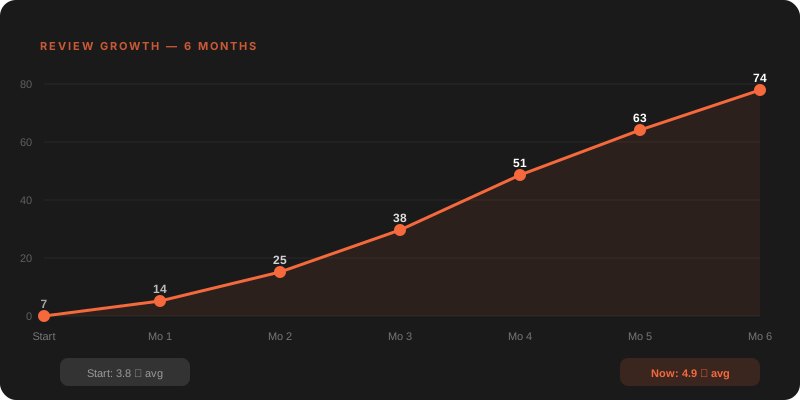
Why Star Rating Has a Non-Linear Impact
Going from 3.8 to 4.0 stars has minimal impact. Going from 4.2 to 4.8 stars changes everything.
Google's research shows that consumers are 270% more likely to trust businesses with 4.7+ star ratings versus those with 4.2. And it's not just trust — it directly affects your Map Pack ranking.
Here's what the star rating thresholds actually mean in practice:
- Below 4.0 — Most users filter you out entirely
- 4.0–4.4 — You're visible, but "safe" competitors will win the click
- 4.5–4.7 — Strong trust signal, competitive at the top
- 4.8+ — Category leader, significantly higher click-through rates
The good news: most local businesses sit in the 3.8–4.3 range because they never had a system for asking. The bar is beatable.
The Biggest Mistake: Asking at the Wrong Time
Most businesses that do ask for reviews make the same mistake — they ask too late, or in the wrong channel.
Too late: A monthly email newsletter asking for a review is easy to ignore. The customer has moved on emotionally.
Wrong channel: Email open rates for review requests average around 18%. SMS open rates average 98%.
The highest-converting review request is an SMS sent 2–3 hours after a job is completed, when the customer still has the positive experience fresh in their mind.
A simple message works better than a complex one:
"Hi [Name], it was great working with you today. If you have 60 seconds, an honest Google review would mean the world to us: [link]. Thanks — [Your name]"
We see 18–24% conversion rates with this format consistently.
How to Handle Negative Reviews (Without Making It Worse)
Negative reviews are inevitable. A business with zero negative reviews is actually viewed with suspicion by consumers — it doesn't look real.
What matters is how you respond.
The wrong way:
- Argue with the reviewer
- Get defensive
- Offer refunds publicly
- Ignore the review
The right way:
- Respond within 24 hours
- Acknowledge the experience ("I'm sorry to hear this wasn't up to our standard")
- Take accountability briefly ("This is not typical of how we operate")
- Offer to make it right offline ("Please call us at [number] so we can sort this out for you")
- Keep it under 3 sentences
You're not writing the response for the unhappy customer. You're writing it for the next 1,000 people who will read that review before deciding to call you.
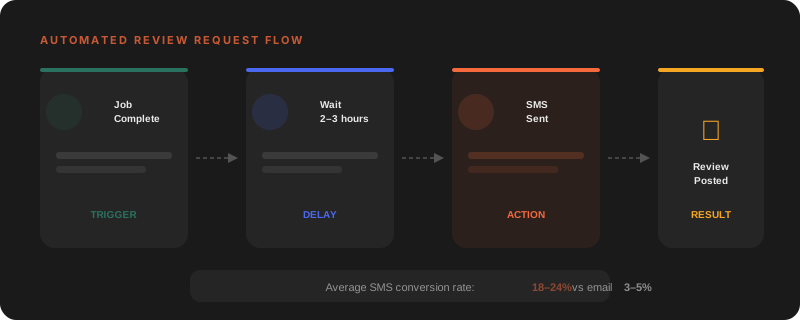
Building a Review Velocity System
One-time review pushes don't work long-term. Google's algorithm rewards consistent velocity — new reviews coming in every week signal that your business is actively serving customers.
The system:
- Trigger: Job marked as complete in your CRM
- Wait: 2–3 hours
- SMS sent: Personalized review request with direct link
- Follow-up: If no review after 5 days, one email follow-up (not SMS)
- Response: Every review responded to within 48 hours
With this system running through GoHighLevel automation, you stop thinking about reviews and they just accumulate.
Realistic targets:
- Month 1: 8–12 new reviews
- Month 3: 25–35 total reviews
- Month 6: 50+ reviews, consistently 4.7+
What to Do With Reviews Beyond Google
Once you're building Google review velocity, the same system can drive reviews on:
- Yelp — Essential for restaurants and home services
- Facebook — Strong for community-based businesses
- Houzz — Critical for contractors and home renovators
- Healthgrades / Zocdoc — Essential for medical and dental
Your automated request can rotate platforms, or you can prioritize Google exclusively for 90 days before expanding.
The Review Funnel: Turn Reviews Into Leads
Reviews don't just help ranking — they're conversion content. Smart businesses use them across:
- Homepage testimonial section
- Google Ads extensions
- Email signatures
- Social media content ("Here's what our customers say")
- Sales proposals
A business with 87 Google reviews at 4.9 stars that showcases those reviews everywhere closes at a higher rate than a business that hides its social proof.
Getting Started
The hardest part of building a review system is the first 10 reviews. After that, momentum builds.
Start with your best customers — the ones who you know had a great experience. Reach out personally, not via automation. Get to 10. Then systematize.
If you want to know exactly where your reviews stand and what's suppressing your rating, our free audit covers review velocity, rating analysis, and a specific action plan for your business type.