Picture this. You've just moved to a new town, and your kitchen sink starts leaking at 7 in the morning. You grab your phone and type "plumber near me." Three businesses pop up at the top. You tap the first one and call. You don't scroll down. You don't compare. You just call.
Now flip it around, because this is the important part: that is exactly how your customers find you. Or don't.
Here's the uncomfortable truth. The plumber who got that call probably isn't the best plumber in town. He's just the one Google chose to show first. And Google makes that choice based on a handful of things. People in the industry give those things a fancy name — "ranking factors" — but all it really means is this: the stuff Google looks at before deciding whose business to put at the top.
And here's the part nobody tells you: you don't need to be techy to understand any of it. By the end of this, you'll know exactly what Google cares about and what to do first.
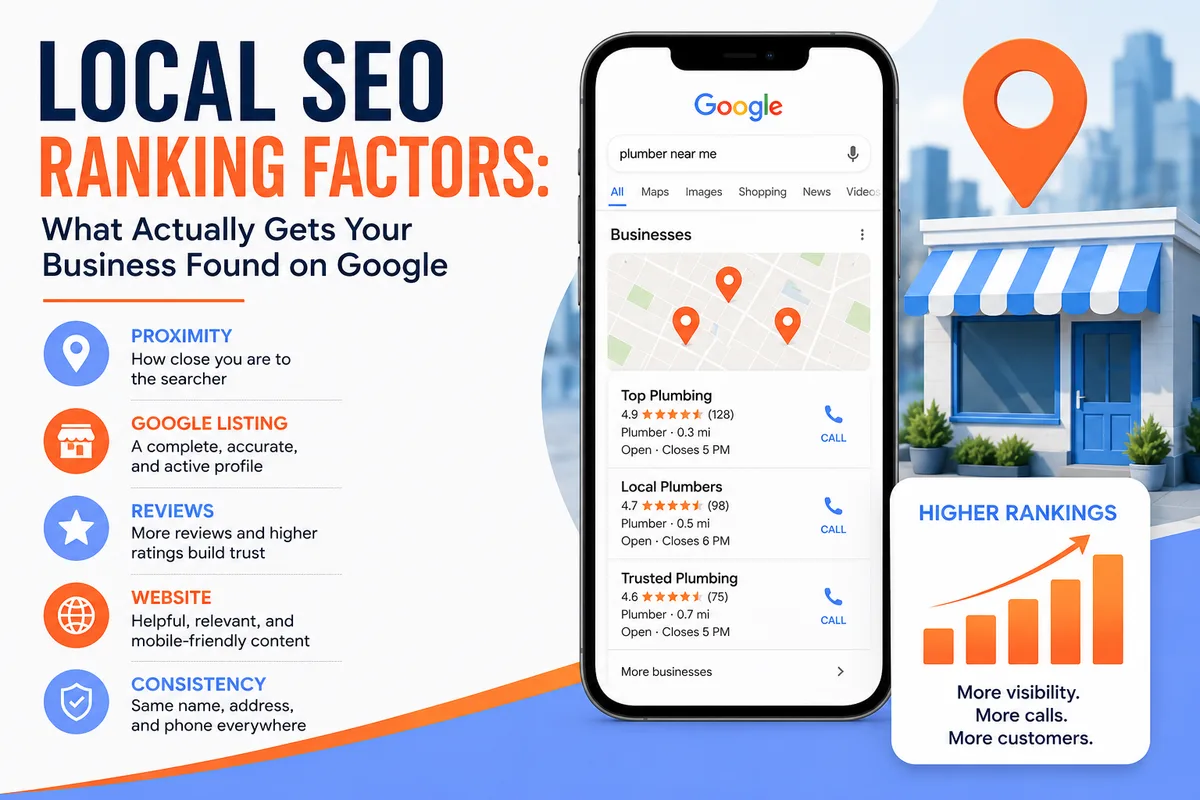
Maybe this sounds a little like you
Be honest — has any of this crossed your mind?
- You do really good work, but the phone just doesn't ring like it should.
- You once looked into "doing SEO" and got buried under confusing advice.
- A competitor you don't think is any better keeps showing up above you on Google.
- You're not even sure where you'd start, so you've put it off.
If you nodded at any of those, you're in exactly the right place. None of this requires special knowledge — just someone to explain it without the jargon. So that's what we'll do.
The easiest way to understand how Google thinks
Forget computers for a second. Imagine you asked a friend who knows your town really well: "Where should I get my car fixed?" Before answering, your friend would quietly weigh up a few things: which shops are nearby, who they know is actually good, and who they've even heard of.
Google does the exact same thing — just for millions of searches at once. When someone searches for what you sell, it asks itself: who's close, who has a good reputation, and who do I have clear information about? The businesses that tick those boxes get shown first.
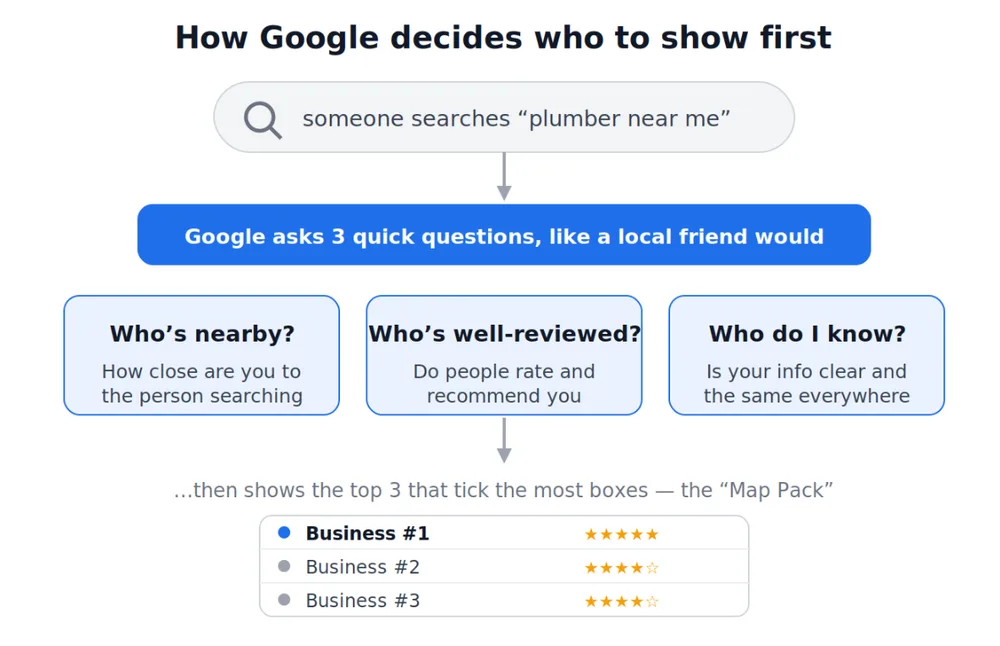
See that box of three businesses at the very top? That has a name — the "Map Pack" — and it's where most of the calls come from. We broke it down in plain English in our guide "What Is the Google Map Pack?" If you're brand new to all this, that's a great companion read.
And here's the single most useful thing in this whole article: those boxes do not count equally. Some matter enormously. Others barely move the needle. Most business owners pour energy into the small stuff and ignore the big stuff. Let's make sure you don't.
What counts, and how much
Here's the honest picture, in plain words:
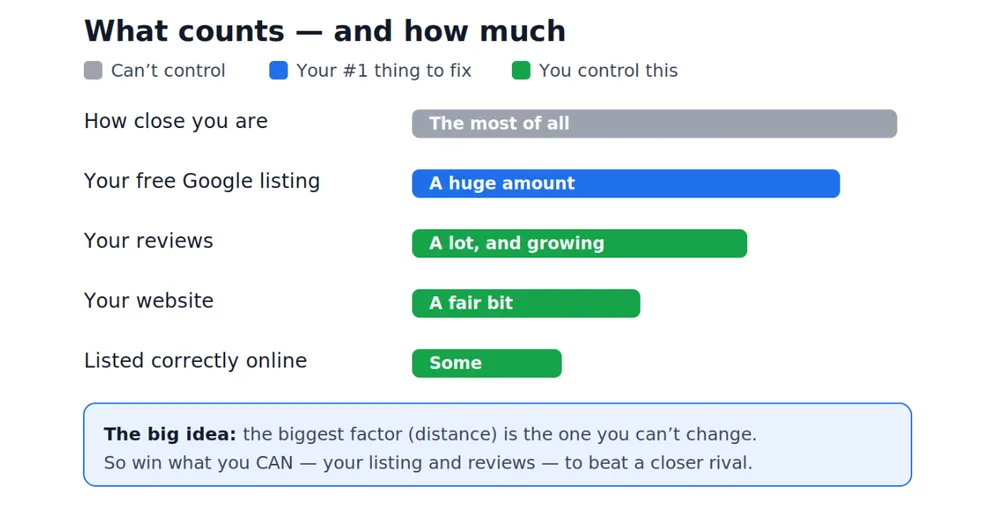
Look at the top bar. The biggest factor of all — how close you are to the person searching — is the one thing you can't change. If someone is standing next to your competitor's shop, that competitor often wins, and that's nobody's fault. It's just geography.
So your real job is simple to say: win everything you CAN control so well that you beat the businesses who just happen to be a bit closer. And almost all of your control sits in two places — your Google listing and your reviews.
So what is this "free Google listing"?
This is the one term worth learning, because it's the heart of everything. Google gives every business a free listing — the box that shows your business name, hours, phone number, photos, reviews, and a little map pin. (Its official name is a "Google Business Profile," but you can just think of it as your free Google listing.)
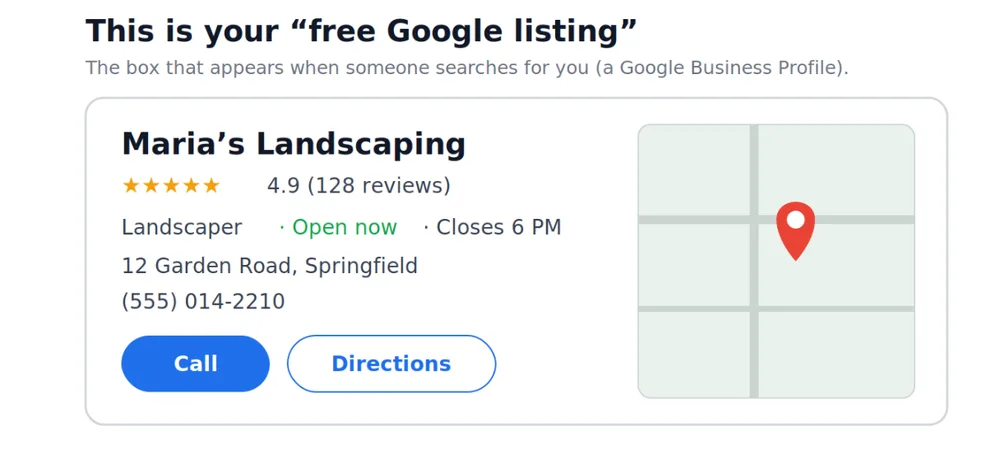
Most businesses either never claim it, or claim it and then forget about it. That's a bit like opening a shop and never turning the lights on. If you do nothing else after reading this, claim that listing and fill it in completely.
What to do first (in plain order)
If I could only give you one to-do list, here it is, top to bottom.
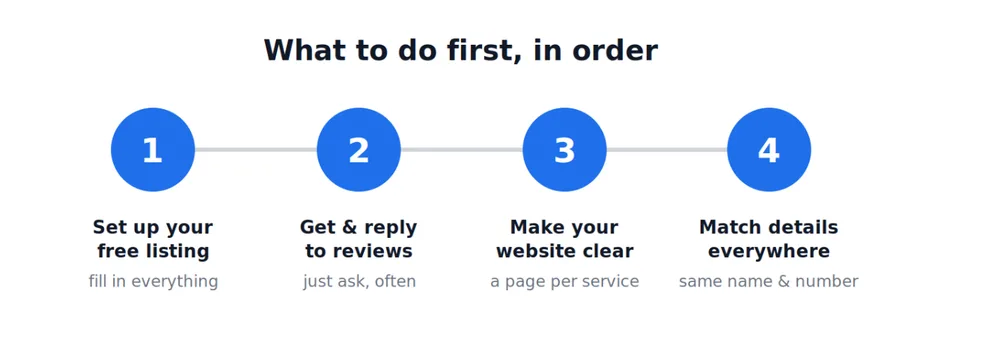
1. Claim and fully fill out your free Google listing.
- Tell Google exactly what you do. There's a spot to choose your main type of business. Be specific — "plumber" is better than "home services." Pick the one that describes how you actually make your money.
- Fill in every box. Hours, phone, address or service area, a description, the services you offer. An empty box is a missed chance for Google to match you to a search.
- Keep your opening hours correct. Wrong hours annoy customers, and Google pays attention to that.
- Add real photos and the occasional update. A listing with fresh photos looks like a real, active business — to people and to Google.
2. Get reviews, and reply to them.
- Just ask. Most happy customers are glad to leave a review — they simply forget unless you ask. Make asking a habit, not a once-a-year thing.
- A steady trickle beats a big burst. A few new reviews every month is better than 20 reviews from two years ago, because Google likes to see that people are still choosing you.
- Reply to them — the good and the bad. A calm, polite reply to a bad review often looks better to a future customer than no reply at all.
3. Make your website clear and helpful.
- Have a simple page for each main service. If you do roofing AND gutters, give each its own page. Google can only recommend things it can clearly see you offer.
- Answer the questions customers actually ask. "How much does it cost?" "Do you cover my area?" Plain answers help you with Google and with newer AI search tools.
- Make sure it works nicely on a phone. That's where most people will see it.
4. Make sure your details match everywhere online.
Same name, address, and phone number, every place you appear. On Facebook, on directories, on your website — all identical. If one place says "Street" and another says "St," Google gets a little less sure you're the real deal, and being sure is what helps you rank.
Things to NOT do (these can actually hurt you)
- Don't cram keywords into your business name on Google. Calling yourself "Maria's Landscaping — Best Cheap Lawn Care Near Me" can get your listing shut down. Just use your real name.
- Don't buy cheap "rankings" or links from strangers online. Google is very good at spotting these, and it can punish you for them. There are no real shortcuts.
- Don't claim your listing and then ignore it. A listing you never touch slowly slips behind the ones that stay active.
Here's the part that trips everyone up
Notice that none of this is hard to understand. That's the trap. Understanding the list is the easy bit. The hard bit is actually doing it — keeping the listing fresh, asking for reviews every week, replying to them, keeping your details tidy across the web — month after month, while you're also busy running your business.
That steady upkeep is exactly what quietly never gets done when you're slammed. And it's the real reason a perfectly good business gets beaten by a competitor who simply stays a little more on top of it.
That's the whole reason Oootech exists. We take this off your plate — setting up and looking after your Google listing, helping you gather and respond to reviews, keeping your details consistent everywhere, and tidying up your website — and we keep it running so you don't have to think about it. No hundred confusing tactics. Just the few things that actually get you found, done properly and kept up.
Curious where your business stands right now?
You don't have to guess. The most useful first step is just seeing the picture: what you're already doing well, what's quietly holding you back, and what the businesses beating you are doing differently.
If you'd like that, we'll take a free look at your business's local presence — no pressure and no obligation. Worst case, you finally understand why you show up where you do. Best case, you fix the few things in the way before your competitor gets around to it.
FAQs
What are local SEO ranking factors, in simple terms?
They're just the things Google looks at before deciding which local businesses to show first. The main ones are how close you are to the searcher, your free Google listing, your reviews, your website, and whether your details are correct around the web.
What's the one thing I should fix first?
Your free Google listing (officially a Google Business Profile). Claim it, fill in every box, choose the right type of business, add photos, and keep your hours correct. It's the biggest thing you can control.
What is the Google Map Pack?
It's the box of three businesses with a map that shows at the top of local searches — powered by your free Google listing. We cover it fully in our guide "What Is the Google Map Pack?"
Do reviews really matter that much?
Yes — a lot, and more every year. Google looks at how many reviews you have, your star rating, how recent they are, and whether you reply. Happy customers will usually leave one if you simply ask.
Why does a worse competitor show up above me?
Most often it's just distance — they may be closer to the person searching, which you can't change. The way to beat them is to do everything you CAN control (listing, reviews, website) really well.
Can I do this myself, or do I need an expert?
You can absolutely start yourself — claiming your listing and asking for reviews costs nothing. The tricky part is keeping it all up consistently over time, which is where many owners get help.
How long until I see results?
Many businesses notice small changes within a few weeks, with bigger improvements over one to three months, depending on your area and competition.