The Search Game Just Changed
Six months ago, a customer in your city typed a question into Google. They didn't scroll through ten blue links. Instead, they got an AI-generated answer that named three businesses in your area — and yours wasn't one of them.
This is what search looks like in 2026.
Answer Engine Optimization (AEO) isn't a buzzword anymore. It's the difference between getting calls and watching your competitor get them instead. If you own an HVAC company, dental practice, law firm, or restaurant, this shift is happening whether you're ready or not.
The question isn't whether AEO matters. It's how quickly you can adapt.
What is Answer Engine Optimization (AEO) in 2026?
Definition and Core Mechanism
Answer Engine Optimization is the practice of structuring your website, business information, and content so that AI systems like ChatGPT, Google AI Overviews, and Perplexity can find you, understand you, and recommend you as a trusted answer.
Here's the key difference: Traditional SEO gets you in the game. AEO gets you picked.
Think of it this way. Old search said, "Here are ten pages that match what you searched for." New search says, "Here's the answer, and here's who we trust to give it to you." AI systems don't distribute traffic evenly. They pick winners based on three things: clarity, credibility, and structure.
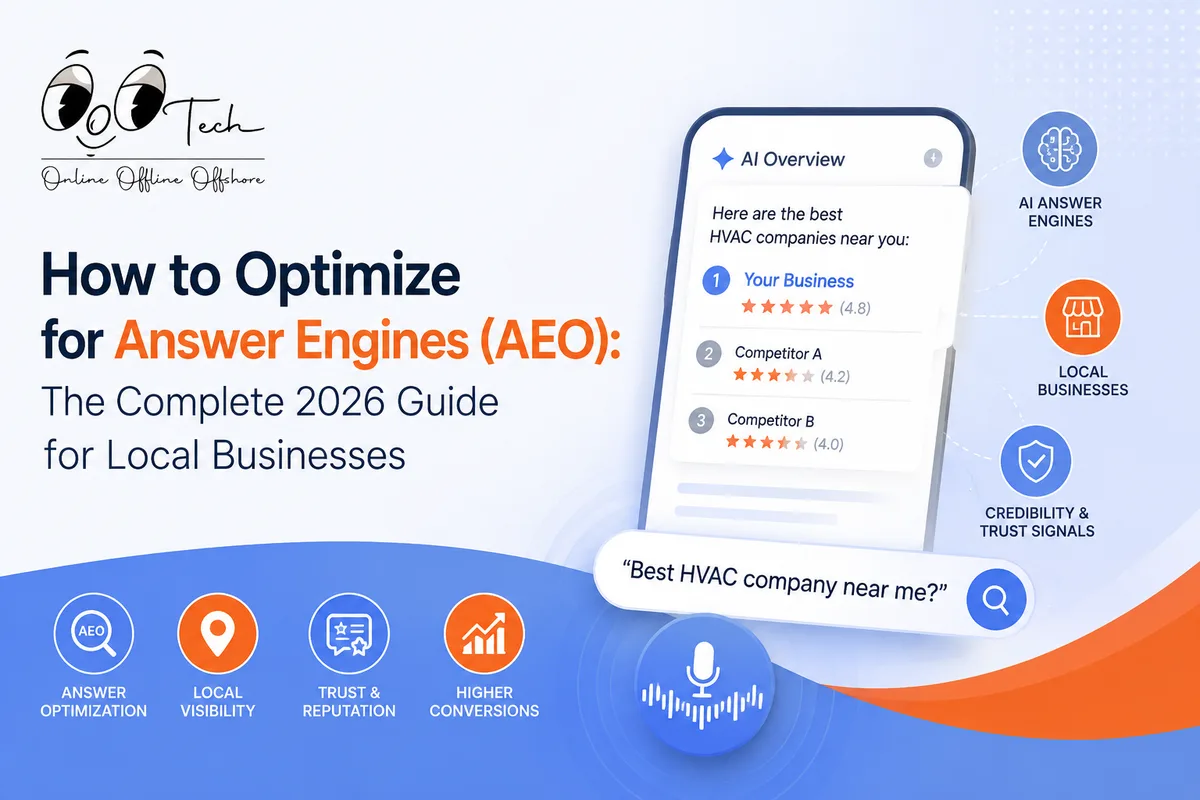
When someone asks "best HVAC company near me," Google's AI doesn't list ten options. It names 2-3 businesses and tells the user why they're worth calling. Being one of those names is the whole game.
Answer Engine Optimization is about making your content so clear and well-structured that AI systems naturally pick you as the answer. The focus isn't on ranking for keywords anymore. It's on being cited as the answer.
AEO vs. Traditional SEO: What Has Changed in 2026?
This matters because SEO and AEO are not the same thing — even though they work together.
Traditional SEO is about getting your website found and ranked in search results. You research keywords, build backlinks, optimize page speed, and compete for position #1. A good SEO strategy still gets you traffic. It still matters.
Answer Engine Optimization is about being extracted and cited by AI. It's about making your content so clear and well-formatted that an AI parser can pull out your answer and present it to the user before they ever click your website.
Here's what this looks like in practice:
| Factor | Traditional SEO | Answer Engine Optimization |
|---|---|---|
| Primary Goal | Rank in search results | Get cited in AI answers |
| Key Signals | Backlinks, domain authority, keyword placement | Schema markup, direct answers, entity clarity, freshness |
| Content Format | Long-form content with keywords | Clear Q&A, definitions, structured data, FAQs |
| User Interaction | Click → Read → Convert | AI cites you → User trusts you → Higher conversion |
Traditional SEO remains essential, but AEO adds another layer: visibility in AI Overviews, mentions in answer engines, and emphasis on structured content, schema, entity clarity, and citation-readiness.
The businesses winning right now do both. They optimize their traditional rankings and structure their content for AI extraction. That's the 2026 playbook.
Why Answer Engines Target Structured Local Entities
The Role of Google Business Profiles and Direct Citations
Here's something most local business owners don't realize: Your Google Business Profile is now one of the most important SEO tools you have. Not just for maps. For AI.
When a customer asks Google "best dentist in Denver," the AI needs to quickly verify that you're:
- A real business
- In the right location
- Currently open
- Actually a dentist
That verification comes from your Google Business Profile. Google AI Overviews pull data from your Google Business Profile when responding to local queries. A complete, accurate, and regularly updated GBP — including service listings, current hours, and a populated Q&A section — helps Google's AI recommend your business.
If your GBP is incomplete, outdated, or inconsistent, AI systems skip you. They move to the next option.
This is why businesses that are serious about AEO start with GBP optimization first. A strong profile isn't just nice-to-have anymore. It's your entry ticket.
How AI Engines Process Customer Reviews and Reputation
AI systems don't just read your words. They read what customers say about you.
Answer engines favor pages that lead with a clear answer, support claims with evidence, and show credible authorship. Customer reviews are part of that credible authorship. They're proof.
Here's how it works: When an AI system decides whether to recommend your business, it analyzes your reviews as raw data. It looks for patterns. Are customers consistently happy? Do they mention specific services you offer? Is your rating higher than your competitors?
Reviews aren't just star ratings anymore. They're unstructured sentiment data that AI uses to determine whether your business is trustworthy enough to recommend.
A business with consistent, recent reviews gets cited more often than one with older reviews. Volume and freshness matter more than perfection.
How Businesses Can Improve Answer Engine Optimization in 2026 (Step-by-Step)
Step 1: Implement Comprehensive Schema Markup (JSON-LD)
Schema markup is code that tells AI systems what your business is and what you offer.
Most local businesses skip this step. That's a mistake.
FAQPage, HowTo, Article, Organization, and Author/Person schema all matter. Schema works best when it matches what's actually on your page and reinforces who you are and what you offer.
Here's what to set up:
LocalBusiness Schema (or specific subtypes like Dentist, Restaurant, HVAC): This tells AI systems your business name, address, phone, hours, services, and rating. Without this, you're invisible to many AI systems.
Service Schema: For each service you offer, create structured data that explains what you do, how much it costs, and how long it takes. An HVAC company should have separate Service schema for "Air Conditioning Repair," "Furnace Maintenance," and "Emergency Service."
FAQ Schema: Take the questions your customers actually ask — "Do you offer emergency service?" "What time can you come?" "How much does a diagnostic cost?" — and structure them as FAQ schema. AI systems love pulling answers from FAQs.
Review/AggregateRating Schema: Structure your star rating and number of reviews so AI can easily extract your reputation.
Don't overthink this. Good heading structure, FAQ schema, and keeping content fresh all matter for AEO. Start with LocalBusiness and FAQ schema. Get those right, and you're ahead of most competitors.
Step 2: Structure Content for Direct Answer Extraction (Question-Answering Units)
AI systems don't read websites the way humans do. They scan for extractable answers.
If a customer asks "How much does it cost for a root canal?" your website should have a clear, direct answer somewhere visible. Not buried in a paragraph. Not vague. Clear.
Here's how to structure your content:
Lead with the Answer: Instead of "Root canal therapy is an endodontic procedure that involves several steps..." write "A root canal in our Denver office costs between $800-1,200 depending on tooth location."
Use Question-Based Headings: Don't write "Pricing Information" — write "How Much Does a Root Canal Cost?" or "What's Your Emergency Service Fee?"
Create FAQ Sections: Most of your content should be formatted as questions your customers actually ask. "Do you offer same-day appointments?" "What insurance do you take?" "Are you open on Saturdays?"
Use Lists and Tables: AI systems extract data from structured lists more reliably than from prose. If you're comparing something, use a table. If you're listing options, use a bulleted list.
Keep Answers Self-Contained: Each answer should make sense on its own. Don't make AI systems piece together information from multiple paragraphs.
Content that answers specific questions performs well: definitions, comparisons, how-to guides, decision-stage FAQs, and expert explainers. Pages that lead with a direct answer perform better than those that bury the answer in long paragraphs.
This doesn't mean your website gets boring. It means your website becomes more useful. You're removing friction for customers who want quick answers.
Step 3: Streamline Local Entity Signals and Review Automation
Now that your website is AEO-ready, you need your entire local presence aligned.
This means:
NAP Consistency Across All Platforms: Your Name, Address, and Phone number must be identical on your website, Google Business Profile, Yelp, your local directory listings, and everywhere else customers can find you.
One typo in a single directory kills your entity consistency signal. AI systems check for matching information across sources to verify you're real.
Keep Your Google Business Profile Fresh: When you update your business information and content, AI systems pick up on changes quickly. Freshness-driven changes (updating outdated content) typically show results faster than trying to build authority from scratch. That means:
- Update your hours weekly (especially if you have seasonal changes)
- Post to your GBP 2-3 times per week
- Answer customer Q&A within 24 hours
- Add new photos monthly
- Update services as you add them
Launch Automated Review Requests: This is non-negotiable. AI systems prioritize businesses with fresh, consistent reviews.
Most businesses don't ask for reviews. So they don't get them. Meanwhile, their competitor (who asks) gets 20-30 new reviews per month and climbs faster in AI-generated answers. The most effective approach: automated SMS or email requests sent to customers right after the job or appointment.
Step 4: Leverage Marketing Automation for Instant Response Signals
Here's something most businesses miss: AI systems monitor how quickly you respond to inquiries.
Fast response signals matter because they indicate you're an active, responsive business. Slow response signals hurt you.
This is where GoHighLevel automation comes in. It's the difference between answering calls in real-time and losing them to voicemail.
Here's what it does:
Missed Call Text-Back: Customer calls and gets voicemail? They automatically get a text: "Thanks for calling XYZ Dental. We got your message. Reply YES to schedule an appointment or call us back at [number]."
Automated Appointment Booking: Instead of playing phone tag, customers text back YES and a chatbot walks them through scheduling an appointment.
Lead Follow-Up Sequences: New inquiry comes in? An automated SMS or email sequence keeps them warm: Day 1 = intro, Day 2 = social proof, Day 3 = gentle reminder to schedule.
Why does this matter for AEO? Because AI systems see quick response and consistent communication as trust signals. Businesses that respond fast and keep customers engaged climb faster in AI-generated answers.
This isn't about replacing your personal touch. It's about never missing a lead in the first place. GoHighLevel automation is included with every Oootech plan — it handles the initial grunt work so your team focuses on closing calls instead of playing phone tag.
Industry-Specific AEO Strategies
AEO for HVAC and Home Contracting Services
HVAC is one of the most competitive local industries for AI-generated answers. Here's why: the stakes are high (emergency furnace breakdown), the customer intent is clear ("I need help now"), and AI systems want to recommend the most reliable option.
What AI looks for in HVAC businesses:
- Specialization signals (emergency service, specific types of units you repair, certifications)
- Fast response time (missed call text-back helps here)
- Strong, recent reviews (AI weighs fresh reviews more heavily)
- Clear service listings (tune-ups, repairs, installations, emergency service)
- Local presence (service area defined, location-specific content)
AEO strategy for HVAC:
- Create separate Service schema for each thing you offer: furnace repair, air conditioning maintenance, emergency service, etc.
- Add FAQ schema for the questions you hear daily: "How much does an HVAC tune-up cost?" "Do you offer emergency service?" "What's included in a maintenance plan?"
- Post frequently to your GBP showing recent work (photos of installations, team at jobs)
- Set up automated review requests sent after every completed job
- Implement missed call text-back so urgent calls get answered immediately
- Create location-specific pages if you serve multiple cities
The contractor who answers fastest and has the most recent positive reviews wins the AI-generated answer. Period.
AEO for Dental and Healthcare Practices
Dental is slightly different. Customers are less urgent (fewer emergencies) but more decision-heavy. They compare practices before choosing.
What AI looks for in dental practices:
- Service clarity (general dentistry, orthodontics, cosmetic, implants, etc.)
- New patient information (do you take insurance, what's your new patient special, how do you handle first appointments)
- Specialist credentials (is the dentist a prosthodontist, orthodontist, etc.)
- Comfort signals (sedation options, kid-friendly atmosphere, testimonials from nervous patients)
- Appointment accessibility (evening hours, weekend appointments, same-day emergency)
AEO strategy for dental:
- Create detailed Service schema for each procedure you offer
- Add FAQ schema for common questions: "Do you take my insurance?" "Can I schedule an appointment online?" "Are you accepting new patients?"
- Make new patient information prominent on your website, GBP, and all directory listings
- Use review content that highlights specific services: "Dr. Smith did my implants and made the process painless"
- Add dentist credentials to your Author schema (license, years of experience, specializations)
- Post patient education content regularly (5 signs you need a root canal, how to prepare for a crown appointment, etc.)
- Use testimonials on your service pages
Dental practices that clearly communicate their services and have high review volume win AI-generated comparisons.
AEO for Law Firms and Legal Services
Legal is the most trust-heavy category. To demonstrate expertise, highlight authors with credible credentials, reference authoritative sources, and build links and mentions from trusted websites.
What AI looks for in law firms:
- Practice area clarity (family law, personal injury, corporate, etc.)
- Attorney credentials and experience (years practicing, types of cases handled, bar status)
- Results proof (case outcomes, settlements, awards — without violating ethics rules)
- Client testimonials (specific, detailed reviews that mention results)
- Thought leadership (published articles, speaking engagements, media appearances)
AEO strategy for law firms:
- Create individual attorney profiles with credentials, practice areas, and photos
- Add Person schema for each attorney (license, specializations, years of experience)
- Use Organization schema with detailed practice area information
- Create FAQ schema for common questions: "What's your fee structure?" "How long does a family law case take?" "Do you offer free consultations?"
- Publish substantive content (blog posts, guides, case studies) that shows expertise
- Encourage detailed client reviews that mention specific outcomes
- Include external citations and references (bar association, legal publications, etc.)
- Update your GBP Q&A regularly with complex legal questions and thorough answers
Law firms that clearly demonstrate authority and have deep client reviews climb fastest in AI answers.
AEO for Restaurants and Hospitality
Restaurant search is different. Customers ask practical questions: Is it open now? What's the vibe? Do they have outdoor seating? Can I book a table?
What AI looks for in restaurants:
- Current information (hours, whether they're open now, recent menu updates)
- Atmosphere description (casual, upscale, family-friendly, date night, etc.)
- Cuisine type and specific dishes (not just "American food")
- Reservation availability and seating options (patio, bar, private dining)
- Dietary accommodations (vegan options, gluten-free, kids menu)
- Price range clarity
AEO strategy for restaurants:
- Keep your GBP hours and menu perfectly current (update immediately if hours change)
- Add detailed Restaurant schema with menu items, prices, and cuisine types
- Use FAQ schema for practical questions: "Do you take reservations?" "Do you have outdoor seating?" "Are you open on Sundays?" "Do you have vegan options?"
- Post frequently to GBP showing current specials, new dishes, busy times, atmosphere
- Encourage reviews that mention specific dishes and atmosphere ("The patio is perfect for date night" vs. just "good food")
- Make your reservation system prominent on your website
- Add OpenHours schema so AI knows exactly when you're open
Restaurants with current information and detailed, specific reviews win local AI-generated recommendations.
Measuring AEO Success: Key Performance Metrics
You can't improve what you don't measure. Here's what to track:
AI Visibility Metrics:
- Citation count: How many times are you cited in AI-generated answers?
- Share of voice: What % of mentions go to you vs. competitors?
- AI appearances by platform: Track mentions in Google AI Overviews, ChatGPT, and Perplexity separately
- Citation trend: Are mentions increasing or decreasing month-over-month?
Business Impact Metrics:
- Calls from AI discovery: How many calls come from AI-generated answer clicks?
- Cost per AI-sourced call: Total marketing spend ÷ calls from AI discovery
- Conversion rate: What % of AI-sourced calls turn into customers?
- Review velocity: How many new reviews per month (AI respects fresh review signals)
Technical Metrics:
- Schema validation: Are all your schema markups passing validation tests?
- GBP health score: Check completeness and freshness weekly
- Citation consistency: NAP accuracy across all directories
- Content freshness: How old is your newest GBP post, FAQ, or page update?
Successful AEO requires regular updates. Weekly updates to your GBP and monthly content refreshes will keep you competitive with faster-moving competitors.
Turn AI Visibility Into Revenue With Oootech
Here's what we know: The businesses winning right now aren't waiting. They're not "testing" AEO. They're implementing it systematically.
That's why we built Oootech.
We help HVAC companies, dental practices, law firms, and restaurants dominate local AI search. Not through guesswork. Through a proven process that combines:
Local SEO Strategy: We research the exact keywords your customers ask AI, then optimize your website to answer them.
Google Business Profile Optimization: We set up and maintain your GBP like it's your most important storefront — weekly posts, photo updates, Q&A management, category optimization.
Schema Implementation: We handle the technical setup so AI systems understand exactly what you offer.
Review Automation: We set up the systems that turn customers into reviewers without you lifting a finger.
GoHighLevel Automation: We implement missed call text-back, automated scheduling, and lead follow-up sequences so you never miss a call.
Citation Management: We audit your listings for accuracy, then sync your NAP across 60+ directories.
Key Takeaways: Your AEO Roadmap for 2026
- AEO is not optional anymore. Search behavior has shifted. AI-generated answers are the new way customers find local businesses. Being in the candidate pool isn't enough. You need to be picked.
- Start with clarity. Make sure your business information is accurate, complete, and consistent everywhere. This is foundational. Schema, GBP, listings — all of it needs to align.
- Structure your content for extraction. AI systems read differently than humans. Lead with answers. Use question-based headings. Structure data. Make it easy for AI to cite you.
- Automate review generation. Fresh reviews are one of the strongest AEO signals. Set up automated requests after every customer interaction.
- Respond fast. AI systems monitor responsiveness. Implement missed call text-back and automated lead follow-up. Speed matters.
- Measure everything. Track AI visibility, review velocity, and business impact. Monthly reporting keeps you accountable and helps you adapt your strategy.
- Do this with a partner who understands local business. AEO isn't a one-time project. It's an ongoing discipline. Having the right team matters.
The window to dominate local AI search is closing. Every month you wait, another competitor in your market optimizes for AEO. By the time you decide to act, they'll already own the AI-generated answers.
The choice is yours. Start now, or explain to your customers why your competitor shows up first.
Ready to see where you stand? Get your free audit — we'll scan your Google presence, review velocity, local rankings, and citation health. You'll see exactly what's costing you calls. No obligation, no sales pitch.