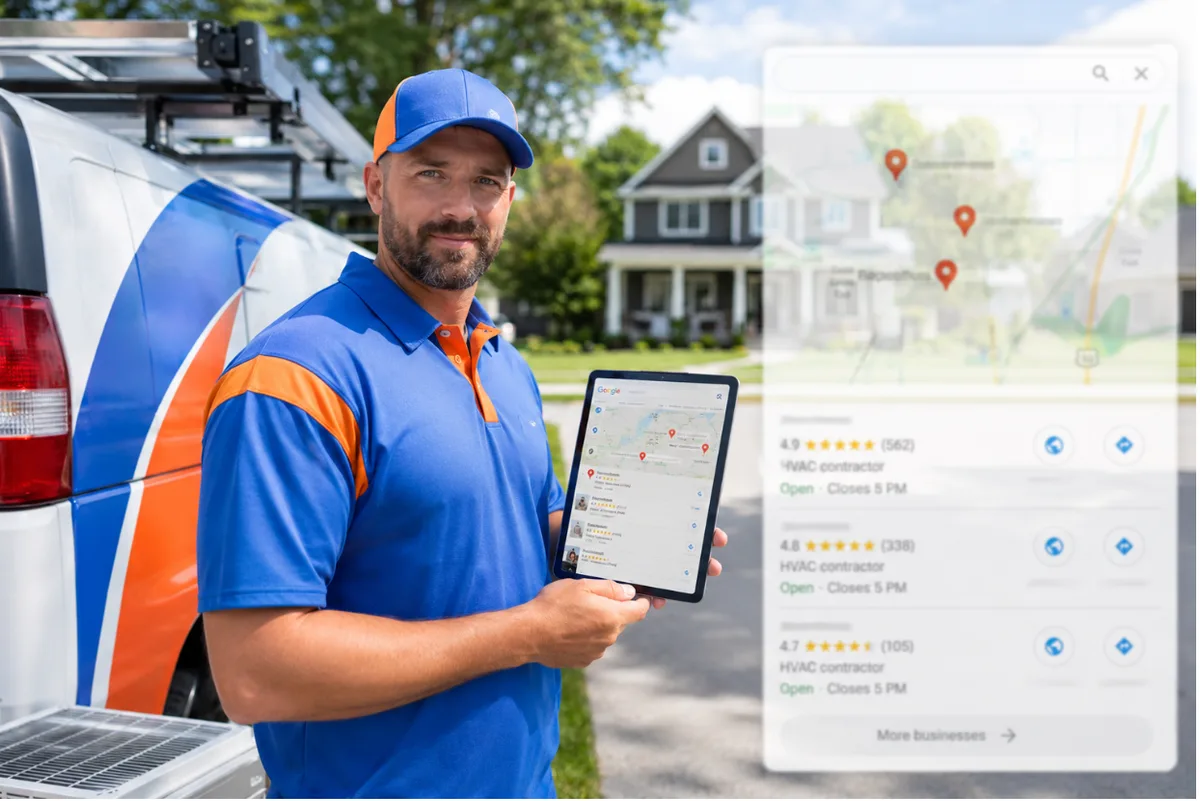
Most HVAC contractors rely on referrals and pay-per-click advertising. They're leaving money on the table.
When a homeowner's air conditioner breaks down at 2 PM on a Saturday, they don't scroll through referrals. They search "AC repair near me" on Google. If you're not showing up in that moment, a competitor is getting the call.
Local SEO is how you capture those high-intent, immediate-need searches. It's not about ranking on page 5 of Google for generic terms. It's about appearing in the Google Map Pack when someone needs you right now.
This guide walks through exactly how HVAC companies rank higher on Google Maps, build citations correctly, earn the reviews that drive calls, and stay visible year-round despite seasonal demand swings. If you implement these strategies, you'll see changes in 90-120 days.
Why Local SEO is the Highest-ROI Marketing for HVAC Contractors
Local SEO generates calls, not just clicks.
A paid search ad might cost $15-40 per click. You're paying whether the person calls you or not. Local SEO attracts people who are actively searching for your service, right now, in your area. The cost per call is usually lower because you're not bidding against every contractor in your region.
Here's the business reality: HVAC is a high-ticket, high-urgency service. A furnace repair or AC installation generates $300-$2,000+ in revenue per job. Your customer acquisition cost needs to reflect that. Local SEO typically delivers a good return on investment within the first year.
How HVAC Homeowners Search for Services (And What It Means for You)
People searching for HVAC services use specific patterns. Understanding these patterns changes your strategy.
The Emergency Search Pattern
"AC repair near me today" or "emergency furnace service" — these are high-intent, immediate-need searches. Someone is uncomfortable right now. They need help within hours, not days.
If your Google Business Profile is optimized, you'll appear in these searches. If it's not, they'll call the first contractor they see.
The Research Search Pattern
"How much does an AC replacement cost?" or "Do I need a new furnace?" — these are research searches. The person is exploring options, not ready to call yet. They might be planning a replacement 2-3 months away.
Local SEO doesn't ignore these searches either. Your website content answers these questions, builds trust, and brings people to your site who eventually call.
The Service Area Search Pattern
"HVAC contractor in [city]" or "AC repair [neighborhood]" — these are location-specific searches. They're looking for someone local. If your Google Business Profile includes your service areas and you have proper citations across directories, you'll show up.
HVAC searches are intensely local. Most homeowners don't want a contractor driving 30 minutes to their house. They want someone nearby.
The Google Map Pack: Why It Generates 70% of Local HVAC Calls
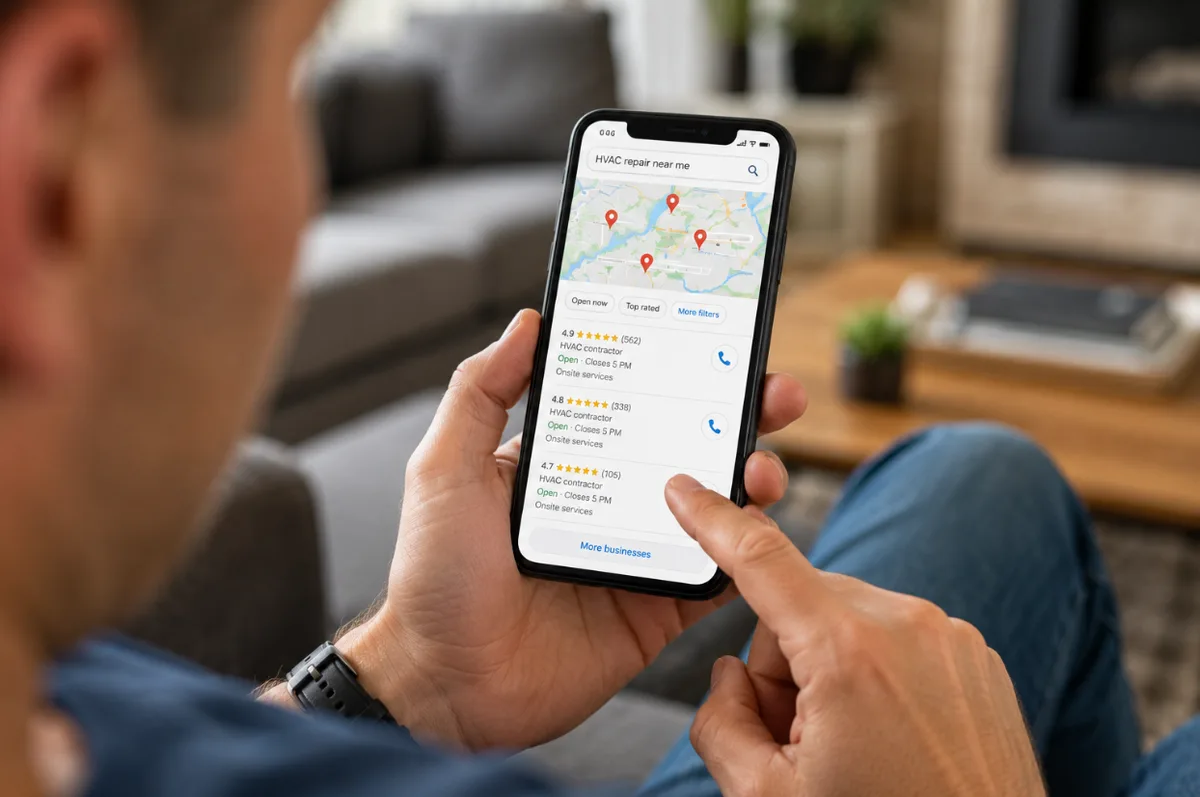
The Google Map Pack is the three-business result that appears when someone searches for an HVAC service in their area.
It looks like this: A map with three business listings, showing business name, star rating, address, phone number, and distance.
Why does it matter? Because 70% of local HVAC calls come through these three spots.
Not from your website. Not from a paid ad. From this map.
The Map Pack is where Google puts the results that best match what the person is searching for. If you're in the top 3, you're getting calls. If you're on page 2, you're invisible.
What the 3 Google Ranking Factors Mean for HVAC
Google ranks businesses in the Map Pack based on three primary ranking factors:
1. Relevance
Does your Google Business Profile match what the person is searching for? If someone searches "furnace repair near me" and your GBP is categorized only as "Air Conditioning Contractor," you might not rank as high as someone with both AC and heating categories.
Relevance also includes your reviews, your photos, and the keywords in your business description. If your reviews mention "furnace repair" and "emergency service," Google knows you do furnace repair.
2. Distance
How far is your business from the search location? Google prioritizes nearby businesses. If you serve a 25-mile radius and someone searches in your service area, you have an advantage over someone 40 miles away.
This is why service area configuration matters. More on that below.
3. Prominence
How well-known is your business in your area? This includes review count, review rating, citation consistency across directories, and how often your business appears in local mentions.
A contractor with 47 4.8-star reviews is more prominent than one with 8 reviews. Google uses this as a trust signal.
The 5 Pillars of HVAC Local SEO
Effective local SEO rests on five pillars. All five matter. Ignoring one weakens the whole strategy.
Pillar 1: Google Business Profile Optimization
Your GBP is your foundation. Your Google Business Profile is the business listing that appears on Google Maps and in local search results. If it's incomplete or incorrect, nothing else matters.
An optimized GBP includes:
- Correct business category (HVAC Contractor or Air Conditioning Contractor)
- Complete and accurate NAP (Name, Address, Phone)
- Service areas clearly defined
- Business description with relevant keywords
- High-quality photos of your team, trucks, and work
- Regular posts about seasonal services
Pillar 2: Citation Building
Citations — the business listings that carry your name, address, and phone number across the web — are online mentions of your company. They appear in business directories, review sites, and industry-specific platforms. Keeping your business listings accurate and consistent is what makes them count.
Citations signal to Google that your business is real and established. A business with citations across 20+ directories ranks higher than one with citations in only 3.
The key is consistency. Your NAP must be identical everywhere. If your address is "123 Main St" on one directory and "123 Main Street" on another, Google sees these as different businesses.
Pillar 3: Review Strategy
Reviews are one of the strongest ranking factors in local SEO. They also influence customer behavior. A business with 4.6 stars and 45 reviews gets more calls than an identical business with 4.8 stars and 5 reviews.
Why? More reviews signal legitimacy. Most homeowners trust a business with dozens of verified reviews more than one with just a few.
Pillar 4: Website Content & Service Area Pages
Your website is where you answer questions, build credibility, and convert prospects into customers.
Service area pages target specific cities within your radius. Instead of one generic "Service Areas" page, you have dedicated pages for each major city: "AC Repair in Denver," "Furnace Service in Boulder," etc.
These pages rank in local search and answer location-specific questions. Behind the scenes, technical elements like site speed, mobile responsiveness, and schema markup round out the advanced SEO that helps those pages compete.
Pillar 5: Seasonal Strategy
HVAC demand is intensely seasonal. AC repair searches spike in June-August. Furnace service searches peak in December-January.
Your content strategy, photos, posts, and keywords should shift with the season. In summer, you're talking about AC maintenance and emergency AC repair. In winter, you're emphasizing furnace service and heating emergencies.
Google Business Profile Optimization for HVAC Companies
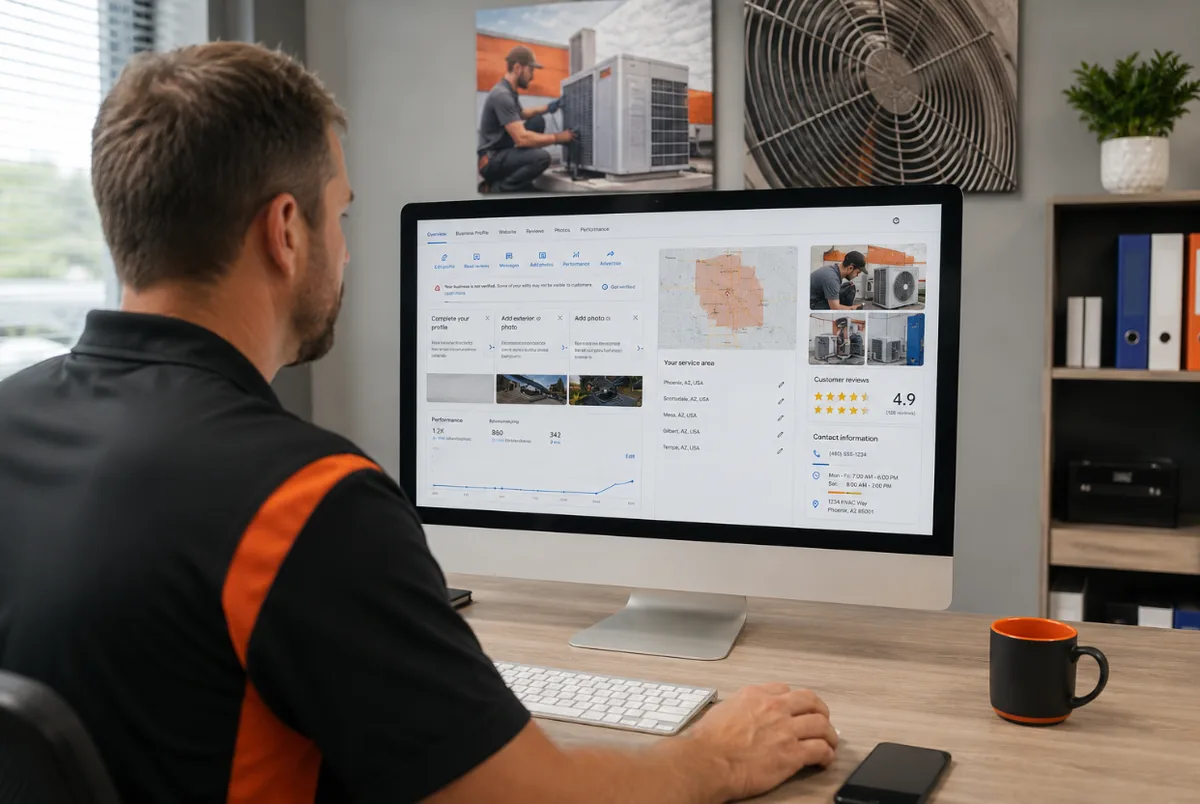
Your GBP is the control center for local search. Invest time here first.
Choosing the Right HVAC Category
This is more important than it seems. Google has specific categories for HVAC businesses:
- HVAC Contractor: Broad category, covers AC and heating
- Air Conditioning Contractor: Specific to AC only
- Heating Contractor: Specific to heating only
If you do both AC and heating (which most HVAC companies do), use "HVAC Contractor" as your primary category. You can add secondary categories like "Emergency Services" or "Water Heater Installation."
The category determines which searches your GBP appears in. Get it wrong, and you'll miss searches you could be winning.
Setting Up Service Areas
Don't list a storefront address if you don't have one. Most HVAC companies are service-area businesses. You service customers at their homes, not yours.
Configure your service areas in GBP by:
- Adding every city, town, and neighborhood you service
- Entering your coverage radius (usually 25-50 miles depending on your market)
- Keeping it realistic. If you say you service 100 miles away but 90% of your jobs are within 30 miles, you're wasting time on far-away searches
Google will show your business more often in searches within your defined service areas. This is a direct ranking advantage.
Seasonal Photo Strategy
Update your GBP photos seasonally. In summer, show AC units, outdoor units, and air conditioning work. In winter, show furnace work, heating maintenance, and emergency calls.
This seems minor. It's not. Photos are ranking signals. When Google sees that your most recent photos are AC work, it boosts your ranking for AC searches.
Also add photos of:
- Your team in branded shirts (builds trust)
- Your trucks with your logo
- Before-and-after photos of installations
- Your office or home base
Citation Building: The Best Directories for HVAC Contractors
Citations are mentions of your business name, address, and phone number across the web. They're like votes for your business's legitimacy.
Not all citations are equal. A citation on Google My Business is worth more than one on a random website. A citation on a major directory like Yelp or Angie's List carries weight. A citation on a sketchy auto-generated directory carries almost none.
High-Priority HVAC Directories
These directories are industry-standard and carry significant ranking weight:
| Directory | Priority | Why It Matters |
|---|---|---|
| Google My Business | Critical | The foundation of local search |
| Yelp | High | Major review and discovery platform |
| Angie's List | High | Trusted by homeowners for contractor reviews |
| Home Advisor | High | Homeowners actively search here for contractors |
| Better Business Bureau (BBB) | High | Credibility and local presence |
| Thumbtack | Medium-High | Homeowners use it to get quotes |
| Local.com | Medium | Local business directory with good authority |
| State Contractor Boards | Medium | Regulatory credibility for licensing |
Build citations in the high-priority directories first. A complete citation on Yelp is worth more than partial citations on 10 random directories.
NAP Consistency Rule
This cannot be overstated: Your NAP (Name, Address, Phone) must be identical everywhere.
If your business name is "Smith HVAC Services," don't list it as "Smith Heating & Air" on another directory. If your address is "123 Main Street, Denver, CO 80202," don't shorten it to "123 Main St, Denver, CO 80202" elsewhere.
Google uses NAP consistency as a trust and relevance signal. Inconsistencies confuse Google and hurt your ranking. They also confuse customers.
Review Strategy: How Many Reviews Does an HVAC Company Need?
More reviews = higher ranking. But the relationship isn't linear.
A business with 15 reviews and a 4.7 rating ranks higher than one with 8 reviews and a 4.9 rating. But a business with 75 reviews and a 4.5 rating will eventually outrank both.
Here's what the data shows:
- Below 10 reviews: Minimal ranking advantage. Customers notice the low count and question legitimacy.
- 10-25 reviews: Good starting point. You're showing consistent customer satisfaction.
- 25-50 reviews: Strong ranking position. You're competing effectively in your market.
- 50+ reviews: Dominant ranking position. You're the trusted choice in your area.
The goal isn't to hit a magic number. It's to build an ongoing review stream that shows you're consistently good at what you do.
Post-Job SMS Review Requests
The fastest way to build reviews is to ask for them immediately after the job.
Send an SMS 2-4 hours after completing a job: "Hi [Customer Name], thank you for choosing us for your AC repair! We'd love your feedback. Click here to leave a review: [link]"
This works because:
- The customer is happy (the job is done)
- They're thinking about the experience (it's recent)
- SMS has a 98% open rate and 30-40% click rate
- It takes 60 seconds to leave a review
Most HVAC companies wait days or weeks. By then, the experience is old and the customer has moved on. Ask while they're satisfied.
You can automate this with platforms like GoHighLevel or Jobber. Set up a text message that goes out automatically after a job is marked complete.
What a Good HVAC Review Looks Like
Not all reviews are created equal. A review that says "Good service" is less useful than one that says "Tom came out to fix our furnace, arrived on time, and had us warm again in 30 minutes. Very professional."
Specific details matter. They help future customers understand what you actually do. They also help Google understand your services.
Encourage detailed reviews by asking specific questions in your follow-up:
- "How was our communication with you?"
- "How quickly did we respond to your call?"
- "Would you recommend us to friends and family?"
Detailed answers to these questions become the foundation of your review profile.
Seasonal SEO: How to Stay Visible Year-Round
HVAC search demand fluctuates wildly by season. Your strategy should too.
Summer Strategy (June - August)
AC repair and AC maintenance searches spike. Homeowners are running their AC systems hard. They're either getting emergency calls or thinking about preventive maintenance.
Your content, blog posts, and GBP posts should focus on:
- "Why is my AC not cooling?"
- "How often should I service my air conditioner?"
- "Signs you need an AC replacement"
- Seasonal photos of outdoor AC units and air conditioning work
Your paid search budget (if you have one) should shift toward AC keywords.
Winter Strategy (December - January)
Furnace repair and heating maintenance searches spike. Heating systems are running constantly. Failures are common in extreme cold.
Your content and posts should emphasize:
- "Emergency furnace repair available 24/7"
- "Why your furnace isn't heating"
- "Winter HVAC maintenance tips"
- "Furnace replacement options"
Switch your GBP photos to heating work. Mention furnace service in your business description.
Shoulder Seasons (Spring & Fall)
Demand drops, but it doesn't disappear. People are servicing their systems before they'll need them heavily. This is your opportunity to own "maintenance" keywords.
Content like "Spring AC maintenance checklist" and "Fall furnace inspection checklist" ranks well during these periods.
How Long Does HVAC Local SEO Take?
This is the question every HVAC owner asks. The honest answer: 60-90 days to see real changes, 6-12 months to dominate your market.
Month 1-2: Foundation Building
You're setting up your GBP, building citations, and optimizing your website. You won't see major ranking changes yet. But you're laying the groundwork.
Expect to:
- Improve GBP visibility
- Fix NAP inconsistencies across directories
- Start collecting reviews
- Get your website optimized for local search
Month 3-6: Momentum Building
By month 3, you should see increases in:
- GBP inquiries and calls
- Website traffic from local searches
- Review count and rating stability
Your ranking in the Map Pack should improve noticeably.
Month 6-12: Dominance
If you've been consistent with reviews, citations, and content, you're now ranking in the top 3 for major searches in your service areas.
You're getting the bulk of the calls for emergency HVAC searches. New customers find you because you're visible.
Why does it take this long? Because Google needs to trust you. It needs to see that you're consistent, legitimate, and actually serving customers. It needs to collect enough reviews and citations to verify you're real.
The time investment is worth it because the results compound. After one year, you're not just getting better results — you're getting a system that generates leads year after year with minimal additional effort.
HVAC Local SEO Checklist (Quick Reference)
Use this checklist to audit your current local SEO and identify gaps.
Google Business Profile (Critical)
- GBP claimed and verified
- Correct business category (HVAC Contractor or Air Conditioning Contractor)
- Complete and accurate NAP
- Service areas defined (all cities you serve)
- Business description includes HVAC keywords
- 10+ high-quality photos
- Regular posts (at least 2-4 per month)
- Posts mention seasonal services
- Review management enabled
- Response to reviews (all of them, within 24 hours)
Citations & Directories (High Priority)
- Listed on Google My Business
- Listed on Yelp
- Listed on Angie's List
- Listed on Home Advisor
- Listed on Better Business Bureau
- Listed on 10+ other industry directories
- NAP identical across all listings
- No duplicate listings
Reviews (Ongoing)
- Post-job SMS review requests automated
- Minimum of 1-2 new reviews per week
- Average rating maintained above 4.5 stars
- Review descriptions are detailed and specific
Website (Strategic)
- Service area pages created for major cities
- Homepage mentions service areas
- Mobile site loads in under 3 seconds
- Contact form is visible and easy to use
- Call button is prominent on mobile
- Local schema markup implemented
- FAQs section addresses common customer questions
Content (Seasonal)
- Summer content (AC repair, maintenance, seasonal guides)
- Winter content (furnace repair, heating guides)
- Service-specific pages (AC repair, furnace repair, duct cleaning, etc.)
- Emergency service information is prominent
Conclusion
Local SEO is the most direct path to more HVAC service calls. It's not fast, but it's reliable and sustainable.
The contractors who rank in the Google Map Pack aren't smarter or more talented than others. They're simply the ones who optimized their Google Business Profile, built citations consistently, earned reviews systematically, and created content that answered their customers' questions.
Start with the foundation: Optimize your GBP and get your NAP correct everywhere. Build citations in the major HVAC directories. Then focus on reviews. Ask every customer, automate the process, and respond to every review.
Within 4-8 months, you'll see measurable increases in calls. Within a year, you could be the first result customers see when they search for HVAC services in your area.
The time you invest now is an investment in years of customer calls ahead. If you'd rather have a team handle the setup and the ongoing work, our HVAC marketing experts can build the system for you.
Frequently Asked Questions
How do I get my HVAC company to show up on Google?
Claim and optimize your Google Business Profile (GBP). Verify ownership, add your complete business information, define your service areas, upload photos, and post regularly. Complete the basics, and you'll start showing up. To rank higher, add citations across industry directories (Yelp, Angie's List, Home Advisor) and collect reviews. NAP consistency across all directories is critical.
How long does HVAC SEO take to work?
You'll typically see improvements within 60-90 days. Visible ranking changes in the Google Map Pack take 4-8 months with consistent effort. Full market dominance (ranking #1-3 for most major searches in your area) typically takes 6-12 months. The timeline depends on competition level, how optimized your competitors are, and how quickly you implement these strategies.
What is the best way to market an HVAC company online?
Use a multi-channel approach: (1) Local SEO for organic visibility in Google Maps and search, (2) Google Ads (PPC) for immediate visibility on high-intent searches, (3) Seasonal content on your website to establish authority, (4) Regular GBP posts about seasonal services, (5) Email or SMS to past customers for seasonal maintenance reminders, (6) Review generation to build social proof. Start with local SEO because it builds an asset you own.
How do I get more HVAC leads?
Optimize for emergency intent searches ("AC repair near me today") by ensuring your GBP is fully optimized and you're easy to contact by phone. Collect reviews consistently to improve your ranking and credibility. Build citations across major directories so Google recognizes you as a legitimate business. Create service area pages for each city you serve. Use seasonal content to capture research searches. Automate review requests via SMS after every job. Most importantly, measure what's working and double down on it.