
Every business owner hits this question eventually: should the next marketing dollar go to Google Ads or SEO?
The honest answer depends on three things — your budget, your timeline, and how long you plan to stay in business.
Google Ads delivers leads this week. SEO delivers cheaper leads next year, and keeps delivering after you stop paying for clicks. Most comparison articles stop right there. They shrug, say "it depends," and move on.
This one won't. Below you'll find current 2026 benchmark data, a 12-month cost-per-lead comparison, and a direct recommendation based on your business size and budget stage.
The Real Cost of Google Ads (What Most Businesses Overlook)
Google Ads has one undeniable strength: speed. Turn it on today, and qualified buyers can be calling by this afternoon. But the price you actually pay is almost always higher than the headline cost-per-click suggests — and if you run a local service business, it usually looks worse.
Here's why. High-intent local verticals like home services, HVAC, and legal sit at the most competitive end of search. When every competitor in town is bidding on the same handful of "I need this fixed now" buyers, click prices climb — and they spike hardest exactly when demand peaks, like emergency AC repair in July or plumbing on a holiday weekend.
Here's the math most businesses skip:
- Clicks are not leads. Only a fraction of the people who click ever fill out a form or call. The rest cost you money and leave nothing behind, which means your true cost per lead is a multiple of your cost per click.
- Leads are not customers. Not every lead closes. Once you factor in your close rate, your real cost per customer is several times your cost per lead — so a "cheap" click can quietly become an expensive sale.
- Management costs are extra. Running ads well takes ongoing work — keyword research, negative keywords, bid adjustments, landing-page testing. Whether you hire an agency or do it yourself, that effort is a real cost, and accounts left on autopilot routinely burn a large share of their budget on clicks that never convert.
And the cost almost everyone overlooks: the meter never stops. Ads buy you visibility only for as long as you keep paying. Pause the campaign, and your lead flow drops to zero the same day. You're renting your spot at the top of the page — not building anything you own.
A big chunk of that waste also happens after the click: a lead lands in an inbox nobody checks, or a missed call never gets returned. You paid for the lead and lost the customer anyway — which is exactly the gap marketing automation and missed-call text-back are built to close.
None of this makes ads bad. It makes them a tool with a specific job — which we'll get to.
What Local SEO Actually Costs and Why It Builds Long-Term Value
Local SEO is a monthly investment rather than a per-click bill — and the size of that investment depends on how competitive your market is and how much work your website needs.
What that money actually buys:
- Google Business Profile optimization — categories, services, photos, posts, and review management. For local businesses, the Google Map Pack drives a huge share of calls, and it costs nothing per click.
- Location and service pages — pages built around what people actually search, like "water heater installation [city]."
- Reviews and citations — review velocity and consistent business listings, both confirmed local ranking factors.
- Content and technical SEO — answering the questions your customers type into Google (and now into ChatGPT and AI Overviews, which pull from the same well-optimized content), plus site speed, mobile usability, and schema markup.
The cost structure is the opposite of ads. With Google Ads, month 1 and month 36 cost roughly the same per lead. With SEO, your cost per lead falls over time because the work compounds:
- A service page that ranks keeps producing leads for years with minor updates.
- Reviews accumulate. A profile with 150 reviews outranks one with 12 — and that lead is hard to take back.
- Rankings build on each other. Once Google trusts your site for one service, related pages rank faster.
The trade-off is real, and you should plan for it: expect 3–6 months before meaningful movement and 6–12 months before SEO matches what ads produce. Any agency promising page-one rankings in 30 days is either targeting keywords nobody searches or about to disappoint you.
One misconception worth killing: ads do not improve your organic rankings. Google has confirmed this repeatedly — paid and organic are separate systems. What ads can do is hand you conversion data that tells you which keywords are worth targeting with SEO.
12-Month Cost-Per-Lead Comparison (What the Curves Actually Look Like)
You don't need exact dollar figures to see the pattern — what matters is the shape of the two curves. The model below assumes a local service business running both channels at a similar monthly budget. Your numbers will vary, but this shape holds across markets.

| Stage | Google Ads Lead Volume | Google Ads Cost Per Lead | Local SEO Lead Volume | Local SEO Cost Per Lead |
|---|---|---|---|---|
| Month 1 | High, immediately | Steady (high) | Almost none | Very high (ramp-up) |
| Month 3 | High | Steady (high) | Building | Falling fast |
| Month 6 | High | Steady (high) | Catching up | Below the ramp |
| Month 8–9 | High | Steady (high) | Comparable | Crosses below ads |
| Month 12 | High | Steady (high) | High | Well below ads |
| Year 2 | Same spend, same leads | Steady (high) | Higher still | Far below ads |
What this table actually tells you:
- Ads win the first stretch on volume. If you need leads now, ads are the answer. No serious SEO consultant disputes this.
- SEO crosses below ads around month 8–9. From that point forward, every SEO lead costs less than every paid lead — and the gap widens monthly.
- Year two is where SEO buries ads. Ads repeat the same spend for the same leads. SEO keeps producing more leads at a lower cost — often while you scale the retainer back to maintenance.
- Stopping changes everything. Cancel ads and leads stop that day. Cancel SEO after a year of real work and the rankings keep producing for months or years.
One honest caveat: SEO results aren't guaranteed the way ad impressions are. A weak agency, a brutal market, or a thin website can stretch that timeline. Vet whoever you hire by asking for ranking case studies in your industry.
When Google Ads Is the Right Choice
Ads are the better first move when:
- You're brand new. No reviews, no rankings, no website authority. Ads are the only way to get found this month.
- You need revenue immediately. Cash-flow problems don't wait six months for rankings.
- The need is urgent and seasonal. Emergency plumbing, AC repair in July, tax prep in March. Buyers in these moments click whatever appears first — and Local Services Ads sit above everything.
- You're testing a new service or market. Two weeks of ads tells you whether "ductless mini-split installation" gets searched in your city. SEO would take six months to answer the same question.
- Your customer value justifies the cost. A lead that's expensive for a low-ticket product is trivial for a five-figure HVAC replacement or a personal-injury case.
The discipline that makes ads work: track leads to revenue, not just clicks. Set negative keywords weekly. Send traffic to dedicated landing pages, not your homepage. Businesses that skip these basics fund Google's ad business without much to show for it.
When SEO Is the Better Investment
SEO is the better allocation when:
- You plan to operate for 3+ years. SEO is an asset purchase. The longer your horizon, the more the compounding works for you.
- Your margins can't absorb paid-search prices forever. Many service businesses simply can't pay per-lead rates at scale and stay profitable.
- Your market searches with research intent. "Best roofing company near me," "how much does a kitchen remodel cost" — these searchers read reviews and compare. Organic results and the map pack win that behavior, and many of these users skip ads entirely.
- Competitors are weak online. In many local markets, the top-ranked competitor has a slow site and a thin review profile. That's a beatable position — and once you take it, it's defensible.
- AI search matters to you. ChatGPT, Gemini, and Google's AI Overviews pull answers from well-structured organic content and strong business profiles — not from ad auctions. SEO work now doubles as AI-search visibility work.
The mistake to avoid: treating SEO as a one-time project. "We did SEO in 2024" is like saying "we did accounting in 2024." Rankings need maintenance — fresh reviews, updated content, technical health — or competitors who keep investing will pass you.
The Combined Strategy: Why Smart Businesses Use Both
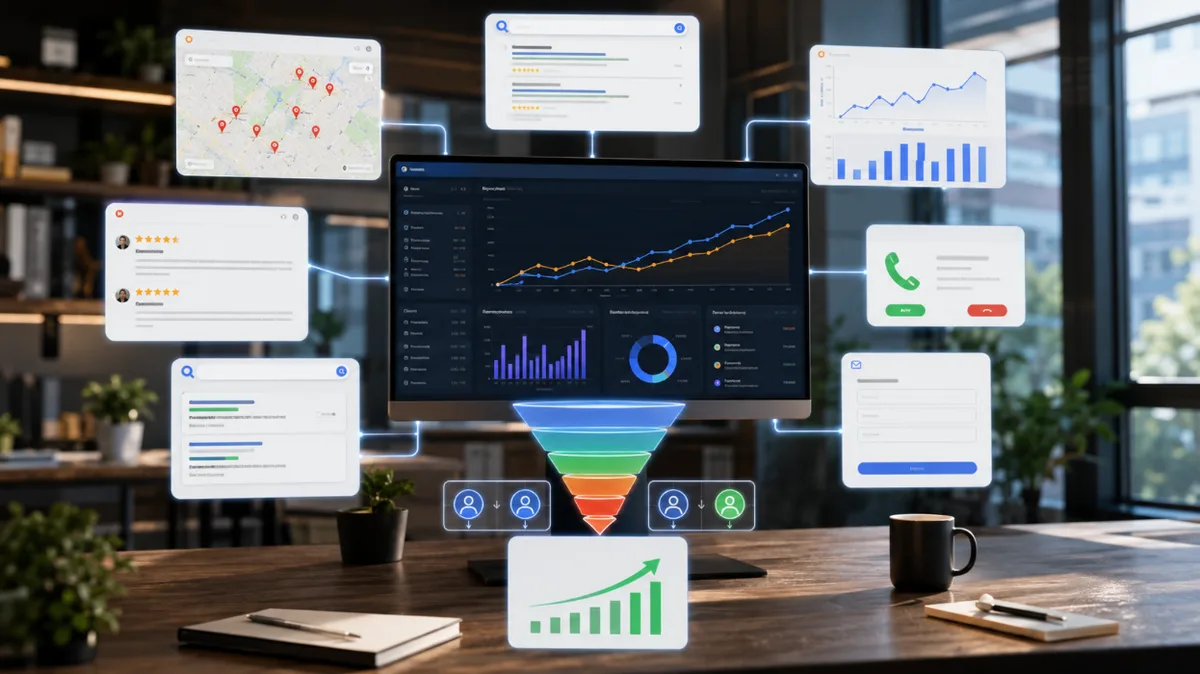
The businesses that dominate local markets rarely choose. They sequence.
Phase 1 (Months 1–6): Ads carry the load. Put the bulk of your budget into Google Ads for immediate leads. Start SEO foundations in parallel — GBP optimization, review generation, core service pages.
Phase 2 (Months 6–12): Rebalance. As organic leads arrive, shift budget. Use your ads conversion data to pick SEO targets: the keywords that already produce paying customers are the ones worth ranking for organically. This is the single most underused advantage of running both.
Phase 3 (Month 12+): SEO becomes the engine. Organic and map-pack visibility handle baseline lead flow at low cost. Keep a smaller ads budget for three jobs: seasonal spikes, high-value emergency keywords, and retargeting site visitors who didn't convert.
There's also a SERP real-estate effect. When you hold an ad, a map-pack spot, and an organic listing for the same search, you occupy most of the visible screen. Combined visibility consistently outperforms either piece alone — searchers read multiple appearances as a trust signal. HVAC contractors are a textbook example of this; see how the top-ranking HVAC companies stack the deck.
Final Recommendation Based on Business Size and Budget Stage
| Your situation | Recommendation |
|---|---|
| New business, very tight budget | Lead with Google Ads (or Local Services Ads) + free DIY basics: claim your GBP, ask every customer for a review |
| Established, moderate budget | Start ads-heavy for 6 months, then flip the ratio toward SEO |
| Established, healthy budget | Run both fully from day one; sequence budget as shown above |
| Mature business, strong rankings already | Lean into SEO/content; use ads only for seasonal and emergency keywords |
| Need leads this week, no exceptions | Google Ads — but start the GBP and review work now anyway, because it's nearly free |
If you're forced to pick exactly one channel and you'll be in business three years from now, pick SEO and accept a slow first six months. If you won't survive six slow months, pick ads and revisit SEO the moment cash flow allows.
Most businesses reading this should do neither extreme. Start with ads for speed, build SEO for cost control, and let the 12-month pattern above guide when to shift the money.
Not sure which stage you're in? Get a free audit of your Google presence — we'll scan your rankings, reviews, listings, and competitors and show you exactly where you're losing calls. No pitch, just a clear picture.
Conclusion
Google Ads and SEO answer different questions. Ads answer "how do I get leads this month?" — predictably and instantly, for as long as you keep paying. SEO answers "how do I stop paying retail for every lead?" — slowly at first, then at a cost per lead that ads can never match.
The pattern is clear: ads win the early months, SEO wins everything after, and the businesses that use ads data to fuel SEO strategy beat competitors running either channel alone.
Decide based on your runway, not on which channel an agency happens to sell. If you'd rather skip the guesswork, Oootech builds the full local-search engine — SEO, reviews, listings, and automation — so your lead flow keeps compounding long after the ad budget would have run dry. Start with a free audit.
FAQ
How much does Google Ads cost per click in 2026?
The cross-industry average sits at roughly $5 per click, based on WordStream's 2026 analysis of 13,000+ campaigns. Local service industries run higher — legal services and home improvement are consistently among the most expensive verticals in search, and competitive emergency keywords in major cities can cost far more than the average.
How long does SEO take to generate leads?
Most local businesses see early movement in 3–6 months and meaningful lead flow in 6–12 months. Low-competition markets and businesses with existing reviews move faster. Brand-new websites in competitive metros sit at the slow end of that range.
Should small businesses use PPC or SEO?
Small businesses on a tight budget should usually start with Google Ads for immediate leads while doing free SEO basics — claiming the Google Business Profile and collecting reviews. Once revenue can support a steady monthly investment, splitting budget between both channels produces the best 12-month outcome.
Do Google Ads improve organic rankings?
No. Google has stated repeatedly that ad spend has zero effect on organic rankings — the systems are separate. The real benefit is data: ads show you which keywords convert into customers, which tells you exactly where to focus your SEO effort.