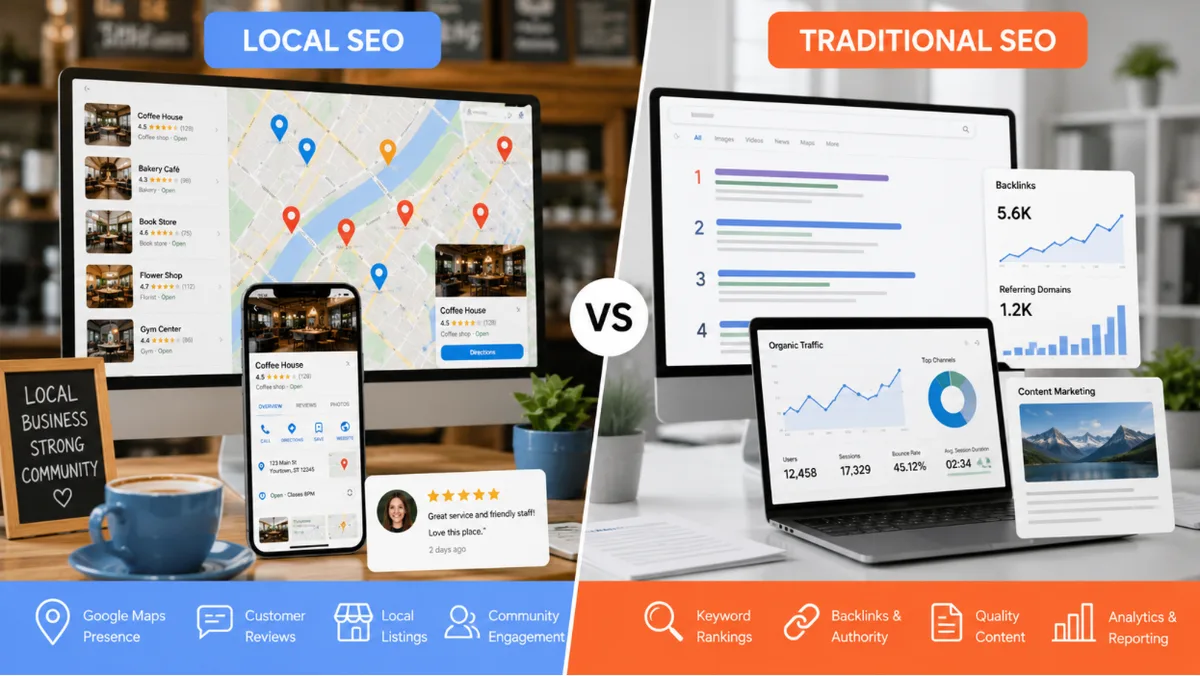
Traditional SEO optimizes your website to rank in the regular organic results for keywords regardless of where the searcher is. Local SEO optimizes your business to rank in the Google Map Pack and local results when someone nearby searches for what you do. The biggest differences come down to ranking factors (content and backlinks vs. Google Business Profile, reviews, and proximity), link building (editorial backlinks vs. local citations), and where you show up (organic links vs. Google Maps). If you serve customers in a specific area, you need local SEO — and ideally a layer of traditional SEO underneath it.
Here's the full breakdown.
Local SEO vs Traditional SEO at a Glance
| Traditional SEO | Local SEO | |
|---|---|---|
| Goal | Rank nationally/globally for keywords | Rank for nearby searchers in your service area |
| Where you appear | Organic ("blue link") results | Google Map Pack + Maps, plus local organic |
| Core ranking signals | Content, backlinks, site authority, technical health | Relevance, distance, prominence (Google's local factors) |
| The hub | Your website | Your Google Business Profile |
| Link building | Editorial backlinks from authority sites | Local citations (NAP listings) + local links |
| Keywords | Broad ("furnace replacement cost") | Geo-modified ("furnace replacement [city]," "near me") |
| Reviews | Minor, indirect | Major ranking and conversion factor |
| Best for | E-commerce, SaaS, publishers, national brands | Contractors, clinics, restaurants, any "serves a city" business |
| Success metric | Organic traffic, keyword rankings | Map views, calls, direction requests, booked jobs |
If you only remember one line: local SEO is everything traditional SEO does, plus a whole layer of local-specific work on top. A local business can't skip the fundamentals — it has to do both, weighted toward local.
What Is Traditional SEO?
Traditional SEO (sometimes called "organic" or "national" SEO) is what most people picture when they hear the term. It's the work of optimizing your website and content to rank in Google's standard organic results for a keyword — no matter where the person searching is located.
It rests on a familiar set of pillars:
- Content that answers what people search and earns its place against the whole internet.
- Backlinks — links from other reputable sites that vouch for your authority.
- On-page SEO — title tags, headers, internal linking, and a good user experience.
- Technical SEO — fast load times, mobile-friendliness, clean structure, HTTPS.
The audience is broad. If you sell a product that ships nationwide, run a SaaS app, or publish content for readers anywhere, traditional SEO is your game. You're competing against everyone, so authority and content depth are what win. This is the territory of content and technical SEO.
What Is Local SEO?
Local SEO optimizes your business to show up when someone near you searches for what you offer — "emergency plumber near me," "best dentist in [city]," "AC repair open now." Instead of competing with the whole web, you're competing with the other businesses in your service area.
It includes everything traditional SEO does, then adds the local layer:
- A fully optimized Google Business Profile (your name, categories, services, hours, photos, reviews).
- Consistent citations — your Name, Address, Phone listed identically across directories. (Business listings are a trust signal Google checks.)
- Reviews, which carry serious weight in local search.
- Geo-targeted content — city and service pages built around the places you serve.
- Google Maps optimization so you appear in the map pack.
The payoff is intent. Local searchers are usually ready to act. According to Google, around 46% of all searches have local intent, and roughly 76% of people who run a "near me" search on mobile visit a business within 24 hours. "Near me" searches have surged dramatically over the past few years. That's not browsing — that's a buyer with their wallet out. (More on why this is the highest-ROI channel in our SEO vs. Google Ads breakdown.)
The Key Differences Between Local SEO and Traditional SEO
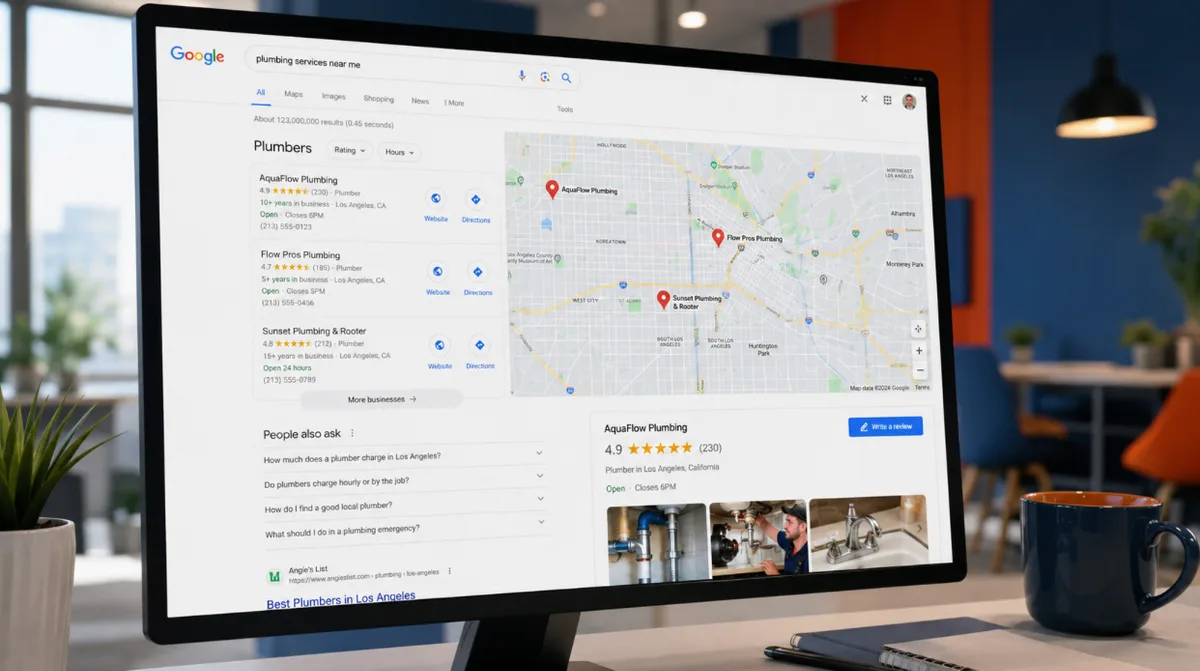
Both share the same DNA. But five differences decide which one moves the needle for your business.
1. Who you're competing against (and the intent behind the search)
Traditional SEO pits you against the entire internet for a keyword. Local SEO narrows the field to businesses near the searcher — and the intent is usually more urgent and transactional. Someone Googling "how does a heat pump work" wants to learn (traditional intent). Someone Googling "heat pump repair near me" wants to hire, now (local intent). Different searches, different strategies.
2. Where you actually show up
This is the most visible difference. Traditional SEO is a fight for the organic blue links. Local SEO is a fight for the Google Map Pack — the box of three businesses with a map that sits at the very top of local results. For "near me" and service searches, the map pack grabs the lion's share of clicks before anyone scrolls to the organic links below it. You can rank #1 organically and still lose the call to whoever owns the map pack.
3. Ranking factors: content and links vs. relevance, distance, prominence
Traditional rankings are driven by content quality, backlinks, and overall site authority. Local rankings run on a different engine. Google states plainly that local results are based primarily on relevance, distance, and prominence:
- Relevance — how well your profile matches the search (categories, services, and the detail in your Google Business Profile).
- Distance — how close you are to the searcher or the location in their query. This factor simply doesn't exist in traditional SEO.
- Prominence — how well-known and trusted you are, online and offline. Reviews and citations feed this heavily.
That's why Google Maps optimization is its own discipline. You can have a high-authority website and still lose the map pack to a competitor with a more complete profile, more reviews, and a closer location. The signals that win the local pack aren't the same ones that win page one organically.
4. Link building and citations: the difference most people miss
In traditional SEO, link building means earning editorial backlinks from authoritative websites — that's how you build the domain authority that ranks broad keywords. It's a core lever, and it's slow, competitive work.
Local SEO leans on a different kind of "link": the citation. A citation is a mention of your business name, address, and phone (NAP) on directories and local platforms — Google, Yelp, Apple Maps, industry directories, the local chamber of commerce. Consistency is everything; even small mismatches (an old phone number, "St." vs "Street") erode trust. Businesses with consistent NAP data tend to outrank those with inconsistent listings, which is why citation and listing management is foundational local work.
Local businesses still want quality backlinks — but they want local ones (sponsorships, local news, partner sites, "best of [city]" roundups) that signal geographic relevance, not just raw authority. So the search phrase people often type — "local SEO vs traditional SEO link building google maps optimization" — really describes three of the biggest practical gaps: link building style, citation work, and Maps optimization all differ between the two.
5. The role of reviews
In traditional SEO, reviews mostly affect brand perception and click-through — they're not a direct ranking lever. In local SEO, reviews are one of the heaviest factors for both ranking and conversion. The vast majority of consumers read reviews before choosing a local business, and a steady stream of fresh, authentic reviews feeds the "prominence" signal directly. A strong review engine is non-negotiable locally and optional nationally. (Here's why reviews are your most valuable local asset.)
Google Maps Optimization: The Lever Traditional SEO Doesn't Have

It's worth pulling this out on its own, because it's the single biggest thing local SEO does that traditional SEO never touches.
Google Maps optimization is the work of getting your business into — and to the top of — the map pack and Maps results. It runs almost entirely through your Google Business Profile: correct primary and secondary categories, a properly configured service area, complete services, fresh photos, and a steady review flow. A complete, well-managed profile makes customers 2.7x more likely to consider your business reputable and 70% more likely to visit, per Google.
No amount of traditional on-page or backlink work substitutes for this. If you serve a local market and you're not actively doing Google Maps optimization, you're leaving the highest-intent calls in your area to competitors. (Our full playbook: how to rank in Google Maps.)
Which Is Better — Geo (Local) SEO or Traditional SEO for Local Businesses?
For a business that serves customers in a specific area, geo-targeted local SEO is almost always the better first investment. Here's the logic:
- The searches that turn into calls and bookings are local and high-intent. Local SEO puts you in front of them at the moment of need.
- The map pack captures clicks before the organic results even get seen, so winning it matters more than ranking #1 organically.
- Local-specific signals (Google Business Profile, reviews, citations, proximity) are levers your national competitors usually ignore — making them easier wins.
But "better" doesn't mean "only." The smartest setup is both, weighted toward local: local SEO to win the map pack and "near me" searches, plus a foundation of traditional SEO (fast, well-structured website; helpful content; city and service pages) to support those local rankings and capture research-stage searchers who aren't ready to call yet. Local SEO sits on top of solid traditional SEO — it doesn't replace it.
The only time a "local business" should lean traditional-first is when it's really a national or e-commerce play wearing a local hat — shipping products nationwide, or building an audience with no geographic limit.
Where AI Search (and "GEO") Fits In
One more wrinkle for 2026: people increasingly ask ChatGPT, Perplexity, Gemini, and Google's AI Overviews for local recommendations — and a newer term, GEO (Generative Engine Optimization), has emerged for optimizing to show up in those AI answers.
The good news for local businesses: the work overlaps heavily with what already wins local SEO. AI assistants pull local recommendations from the same well-structured business information, strong profiles, and reviews. In fact, BrightLocal found that only about 68% of business contact info on ChatGPT and Perplexity matches what's on Google Business Profiles, and many AI users cross-check on Google anyway. Translation: a clean, complete, consistent local presence is now doing double duty — it ranks you in Google's map pack and makes you the business the AI engines recommend. The fundamentals of local SEO are quietly becoming your AI-search strategy too.
How to Decide: Which Do You Need?
| Your business | Lead with |
|---|---|
| Contractor, clinic, restaurant, salon, law firm — serves a city/region | Local SEO (with a traditional SEO foundation) |
| Multi-location brand (chain, franchise) | Local SEO at scale + traditional for brand terms |
| E-commerce shipping nationwide | Traditional SEO |
| SaaS, app, or online-only service | Traditional SEO |
| Publisher / content site | Traditional SEO |
| Local business also selling online | Both — local for the service area, traditional for the store |
If customers come to you (or you go to them) within a defined area, local SEO is where your money works hardest.
Frequently Asked Questions
What is the difference between local SEO and traditional SEO?
Traditional SEO optimizes your website to rank in organic results for keywords regardless of the searcher's location, driven by content, backlinks, and site authority. Local SEO optimizes your business to rank in the Google Map Pack and local results for nearby searchers, driven by your Google Business Profile, reviews, citations, and proximity. Local SEO includes traditional SEO fundamentals and adds a location-specific layer on top.
Is local SEO harder than traditional SEO?
In one sense, yes — local SEO requires everything traditional SEO does plus extra work: Google Business Profile optimization, citation consistency, review generation, and Google Maps optimization. But local keywords are usually less competitive than broad national terms, so a local business can often see results faster within its service area.
Do local businesses still need backlinks and traditional SEO?
Yes. Local SEO sits on top of a solid website. You still need fast, well-structured pages, helpful content, and quality (ideally local) backlinks. Without that foundation, your local rankings and conversions both suffer.
Which is better, geo (local) SEO or traditional SEO, for local businesses?
For a business serving a specific area, geo-targeted local SEO is the better first investment because it captures high-intent "near me" searches and the map pack. The ideal approach is both — local SEO to win local searches, with traditional SEO underneath to support those rankings and reach research-stage customers.
Does local SEO help with ranking in ChatGPT and other AI tools?
It does. AI assistants pull local recommendations from structured business data, complete profiles, and reviews — the same things that power local SEO. Keeping your Google Business Profile and listings accurate and consistent improves both your map-pack rankings and your visibility in AI-generated answers.
The Bottom Line
Local SEO vs traditional SEO isn't really an either/or for most businesses — it's a question of weighting. Traditional SEO builds broad authority and reaches searchers anywhere. Local SEO wins the map pack, the "near me" searches, and the high-intent calls happening right in your service area — through Google Business Profile, reviews, citations, and Google Maps optimization that national SEO never touches.
If you serve customers in a specific area, put local SEO first and build it on a healthy traditional-SEO foundation. That combination wins the calls today and the authority that compounds tomorrow.
Want to know exactly where your local visibility stands — and what's costing you map-pack rankings right now? Grab a free audit and we'll show you. Or see how Oootech's local SEO program handles the whole stack — profile, reviews, listings, and Maps — so you show up when nearby customers are ready to buy.
Keep reading: Local SEO Ranking Factors · What Is the Google Map Pack? · How to Rank in Google Maps