
A business citation is any online mention of your business's core details — usually your Name, Address, and Phone number (NAP), and often your website. These mentions appear on directories, maps, apps, and other websites. They tell search engines your business is real, active, and located where you say it is, which is why they're a foundation of local SEO.
That's the short version. Below, you'll find what citations are, the types, how they affect your Google rankings, how to build them, and whether they still matter in 2026 (they do — just differently than before).
Quick answer: Business citations are online references to your business name, address, and phone number on directories, maps, and other sites. In local SEO, they act as trust and verification signals — the more consistently your details appear across reputable sources, the more confident Google is that your business is legitimate, which supports your local rankings.
What Are Business Citations in Local SEO?
A business citation is an online listing or mention that includes your business information. At minimum that's your NAP — Name, Address, Phone. Often it also includes your website, hours, categories, and a description.
You'll see them in places like Yelp, Apple Maps, Bing Places, your local Chamber of Commerce site, or a "best plumbers in town" blog post. Each one is a small vote of confidence that your business exists and matches the details on your Google Business Profile.
Here's the thing most people miss: Google doesn't take your word for it. When you claim a profile, Google cross-checks your details against the rest of the web. If a dozen trusted sources all show the same name, address, and phone number, Google trusts that data. If they conflict, Google gets unsure — and uncertainty rarely ranks well. Citations are how you give Google a consistent story to verify.
That's why local citations sit underneath almost every other local SEO effort. Your website, your content, your reviews — they all work better when your citation data is clean and consistent.
Why Business Citations Matter for Local SEO
Citations do a few specific jobs, and each one ties back to how Google ranks local businesses.
They support local pack rankings. Google's local results — the map pack of three businesses near the top — are decided by relevance, distance, and prominence. Citations feed the prominence layer. A business confirmed by many independent sources looks more established than one Google can barely verify.
They're a trust signal. Consistent details across reputable sites tell Google your business is real and stable. This is the "trust layer" for your Google Maps ranking. Think of citations as the evidence Google uses to back up what your profile claims.
They validate your business as an entity. Modern search is entity-based. Google wants to confirm your business is a distinct, real-world thing with a fixed identity. Matching citations across the web build what amounts to a data-confidence score that a single-source business can't match.
They help suppress duplicates. Clean, consistent listings make it easier to spot and remove duplicate or outdated entries that split your ranking signals and confuse customers.
This is the work we handle inside managed business listings — getting the data right once, in the right places, so the rest of your local SEO has a solid base.
Types of Business Citations
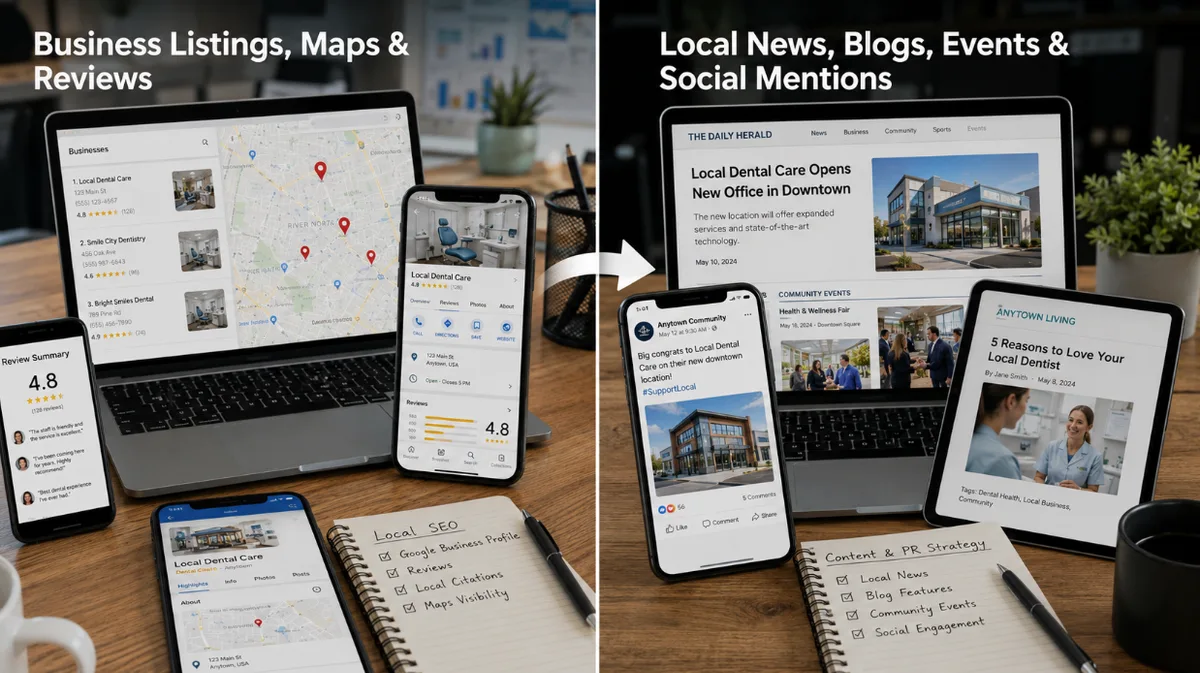
Citations come in two forms. You want both, but they play different roles.
Structured Citations
Structured citations are formal listings on platforms built to display business data in an organized, consistent format. These are the ones search engines parse most easily, so they tend to have the strongest direct effect on local rankings.
They include:
- Directories — Yelp, Yellow Pages, Bing Places, Apple Maps, Facebook, BBB, Foursquare.
- Data aggregators — the wholesale suppliers of business data (more on these in the strategy section). They push your details out to hundreds of smaller directories and apps automatically.
Unstructured Citations
Unstructured citations are informal mentions of your business on sites that aren't directories. They don't follow a set format, but they still signal that you're a real, recognized part of your community.
They include:
- Blog mentions and "best of [city]" roundups
- Local news articles and features
- Local PR, sponsorships, and event listings
- Social media posts that include your business details
Structured citations excel at precise NAP validation. Unstructured ones build contextual trust from authoritative local sources. A natural profile has a healthy mix of both — that mix is what signals a genuine business rather than a directory-spam play.
Core Elements of a Business Citation (NAP + W + S)
A citation is only as useful as the data inside it. The core elements:
- Name — your exact business name, the same everywhere.
- Address — your physical location, in a consistent format (don't switch between "St." and "Street").
- Phone — one consistent number and format.
- Website — your main URL.
- Categories — the business type, kept consistent so Google reads a clear signal.
The phrase you'll hear is "NAP consistency," and the keyword is exact. "ABC Plumbing" on one site, "ABC Plumbing LLC" on another, and "A.B.C. Plumbing" on a third look like three signals to a search engine, not one. Category consistency matters too — being a "plumber" on one platform and a "home services contractor" on another sends mixed messages about what you actually do.
How Citations Improve Google Business Profile Rankings
Citations don't work in isolation. They reinforce the signals already on your Google Business Profile.
Google ranks local results on relevance, distance, and prominence. Your profile sets the baseline; citations confirm it. When your NAP, categories, and details match across Yelp, Apple Maps, Foursquare, and dozens of directories, Google's confidence in your profile goes up. That confidence is part of the prominence signal that decides who lands in the map pack.
There's also a synergy with reviews. A profile backed by consistent citations and a steady flow of reviews looks far stronger than one with either alone. Reviews show activity and reputation; citations show stability and legitimacy. Together they build the kind of trust Google rewards. (Here's more on building that review flow and the wider set of local ranking factors.)
Citation Building Strategy (Step by Step)
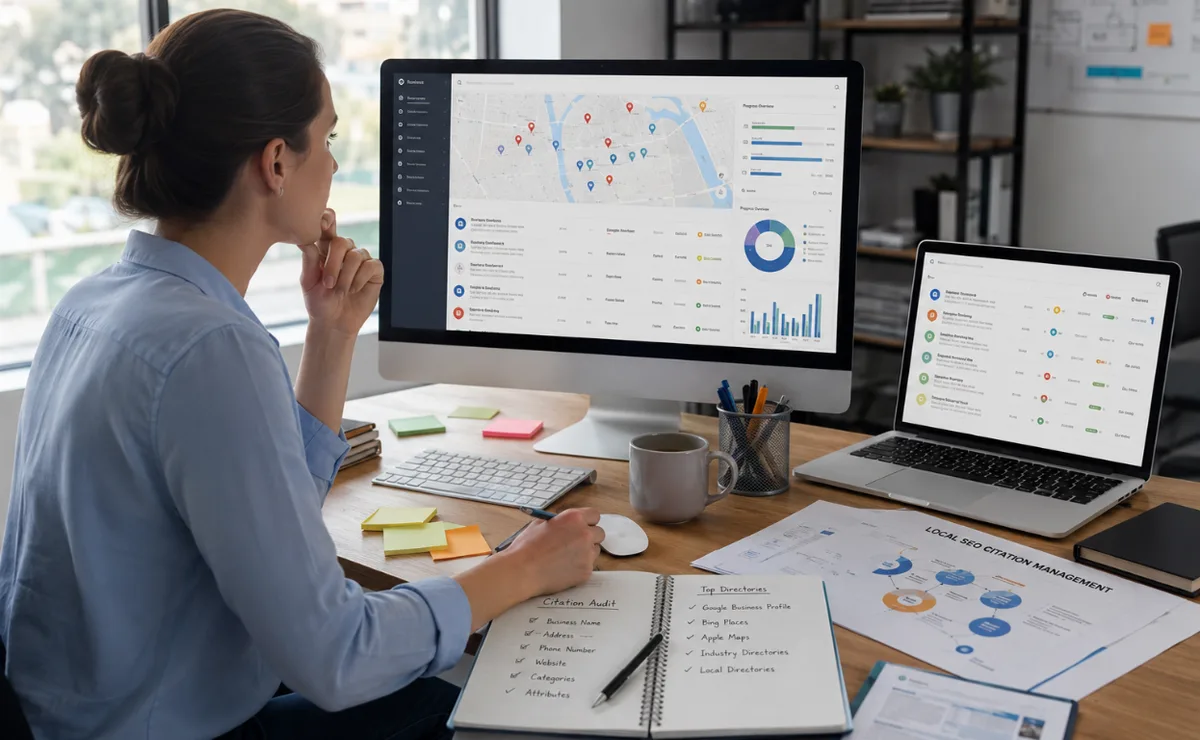
Citation building isn't about racking up hundreds of listings. It's about reducing confusion and reinforcing one clear, consistent identity. Here's the order that works.
Step 1 — Fix NAP consistency first
Before you build anything, lock down your "source of truth." Decide your exact business name, address format, and phone number, and match it to your website footer and your Google Business Profile. Every citation you create or fix from here uses that exact version. Skipping this step just spreads inconsistency faster.
Step 2 — Submit to data aggregators
Data aggregators are the wholesalers of business data. Submit once, and they feed your details to hundreds of downstream directories, maps, and apps. In the US, the main players are Data Axle (formerly Infogroup), Foursquare (which now includes Factual's data), and Neustar Localeze (now TransUnion Digital Business Profile). Fixing your data here is the highest-leverage move you can make — though it can take 4–12 weeks to fully cascade.
Step 3 — Build Tier 1 citations
Claim and complete the core directories every business needs: Google Business Profile, Apple Business Connect (Apple Maps), Bing Places, Yelp, Facebook, Foursquare, and BBB. Fill each one out fully — NAP, categories, hours, description, photos, website. Complete listings consistently beat half-finished ones.
Step 4 — Add niche and local citations
Layer in directories specific to your industry and area. Home services have Houzz, Angi, and HomeAdvisor. Healthcare has Healthgrades and Zocdoc. Legal has Avvo. Then add hyper-local sources: your Chamber of Commerce, city business portals, and local associations. These carry strong relevance because they tie you to both a niche and a place.
Step 5 — Earn unstructured citations
Finally, pursue the natural mentions: sponsor a local event, get featured in a local paper, partner with nearby businesses, or land on a "best in [city]" list. These are harder to get, which is exactly why they carry weight.
Best Business Citation Sites (Tier Breakdown)
Not all citation sources are equal. Prioritize like this:
- Tier 1 — Core directories (everyone needs these): Google Business Profile, Apple Business Connect, Bing Places, Yelp, Facebook, Foursquare, BBB.
- Tier 2 — Industry-specific directories: Healthgrades and Zocdoc (medical), Avvo (legal), Houzz, Angi, and HomeAdvisor (home services), TripAdvisor and OpenTable (hospitality).
- Tier 3 — Local and hyper-local sources: Chamber of Commerce sites, city business directories, local newspapers, and community association pages.
To find, audit, and manage these at scale, citation tools help: BrightLocal, Moz Local, Whitespark, and Semrush Listing Management can scan directories, flag inconsistencies, and track where your business appears. For a single-location business, a careful manual approach works fine. For multiple locations, a tool or a managed listings service saves serious time and prevents data drift.
Common Citation Mistakes That Hurt Rankings
A few errors show up constantly, and each one quietly drags on your visibility:
- Duplicate listings. Two entries for the same business split your ranking signals and confuse customers. Find and remove them.
- Inconsistent phone or address formats. Even small differences — a different area-code format, "Ste" vs "Suite" — register as mismatches.
- Wrong or shifting categories. Mixed categories blur what your business actually does.
- Old addresses or numbers. When you move or change a number, stale citations keep pointing the wrong way and erode Google's trust.
The fix for all of these is the same: one canonical NAP, applied everywhere, audited periodically. Citation building isn't a one-time task — old data resurfaces and details change, so a quick audit every few months keeps things clean.
Citations vs Backlinks (An Important Clarification)
People often confuse these, so let's be clear: they're different tools with different jobs.
A backlink is a link from another website to yours. Its main value is authority — it helps your site rank in the regular organic results, the heart of traditional SEO.
A citation is a mention of your business details, with or without a link. Its main value is verification and trust for local search — it confirms your identity and supports your map pack rankings.
In a local SEO context, citation consistency often matters more than raw link authority. A spotless, consistent citation profile can lift a local business that has very few backlinks, while inconsistent NAP data can hold back a business with strong links. They're not competitors — backlinks build authority, citations build local trust. (We unpack this split further in local SEO vs traditional SEO.)
Do Business Citations Still Matter in 2026?
Yes. They matter as much as ever, though their role has shifted.
Citations have become entity-verification signals. Google's AI-powered local results and AI Overviews lean heavily on confirming that a business is a real, distinct entity with consistent, cross-verified information. The more consistently your NAP and categories appear across trusted sources, the more confidently Google's AI can surface and recommend you.
The same logic extends to tools beyond Google. When someone asks ChatGPT or a voice assistant for "a dentist near me open now," the answer draws on the quality of business data across the web. Clean citations feed those systems too. So citations aren't fading with AI search — they're part of how you show up in it.
What has changed is the goal. It was never about spamming hundreds of directories. In 2026 it's clearer than ever: a citation campaign should reduce ambiguity about who and where you are, not create a pile of near-duplicate listings with stale data. Accuracy beats volume.
The Takeaway
Business citations are the online mentions that prove your business is real, consistent, and where it claims to be. They feed the trust and prominence signals behind your local rankings, they reinforce your Google Business Profile, and in 2026 they help AI and voice search confirm and recommend you. Get your NAP consistent, build the core listings, add the niche ones, and keep them clean over time.
If auditing directories and chasing down inconsistent listings isn't how you want to spend your week, that's exactly what Oootech's business listings and citation management handles — accurate data, built once and maintained. Want to see where your citations stand right now? Grab a free audit and we'll show you the inconsistencies costing you local visibility.
Frequently Asked Questions
What is a business citation?
A business citation is an online mention of your business's core details — name, address, phone number, and often your website — on directories, maps, apps, or other websites. Citations help search engines and customers confirm your business is real and located where you say it is.
Are citations still important for SEO?
Yes. Citations remain a core part of local SEO. In 2026 they also serve as entity-verification signals that help Google's AI-driven and voice search results confirm and recommend your business. Consistent, accurate citations support your local rankings; inconsistent ones can suppress them.
How many citations do I need?
There's no fixed number. Quality and consistency beat quantity. Start with the core Tier 1 directories and the main data aggregators, then add the niche and local sources relevant to your industry and area. A focused set of 20–50 accurate, complete citations usually serves a local business better than hundreds of sloppy ones.
Do citations improve Google Maps ranking?
Yes. Citations reinforce the prominence and relevance signals Google uses for local and map pack rankings. When your business details are confirmed consistently across many trusted sources, Google trusts your profile more, which can improve your Google Maps visibility.
What is NAP consistency?
NAP consistency means your business Name, Address, and Phone number appear exactly the same across every online listing and mention. Exact matching — same name, same address format, same phone format — helps search engines trust your data and is the foundation of effective citation building.