Local SEO for dental practices is the work of getting your practice to show up when nearby patients search for a dentist — "dentist near me," "emergency dentist open now," "dental implants in [city]." It centers on your Google Business Profile, patient reviews, accurate listings, and treatment-specific website content. Done right, it lands you in the Google map pack, the three results that capture the majority of clicks before a patient ever compares options.
Dental is competitive, and patients decide fast. Here's how to be the practice they find and trust first.
Quick answer: To improve local SEO for your dental practice, fully optimize your Google Business Profile with the primary "Dentist" category plus specific secondary categories, build a steady flow of patient reviews (handled within HIPAA rules), keep your name, address, and phone consistent everywhere, and publish dedicated pages for each treatment in each city you serve. Google ranks local results on relevance, distance, and prominence — and these moves strengthen all three.
Why Local SEO Matters for Dental Practices
Yes, local SEO works for dentists — and it's one of the highest-return investments a practice can make.
Picture the moment: it's 8 p.m., someone cracks a tooth, and they search "emergency dentist near me" on their phone. They don't read your About page or compare five websites. They tap one of the first practices with strong reviews and call. The Google map pack — the boxed top three results — captures most of those clicks, so if you're not there, most patients never find you.
Three things make dental local SEO especially worthwhile. Patient intent is high: someone searching for a dentist usually needs one soon. Patient value is high: a single new patient can be worth thousands over the relationship, which makes even a modest ranking gain valuable. And it compounds: reviews accumulate and rankings hold, building an asset that keeps producing patients without paying per click. (For the paid-vs-organic tradeoff, see our SEO vs. Google Ads breakdown.)
How Google Ranks Dental Practices Locally
Google ranks local results on three factors, and every tactic below works on at least one:
Relevance — how well your practice matches the search, driven by your categories, listed services, and content.
Distance — how close your office is to the searcher. It's the heaviest factor and the one you can't control, so you maximize everything else.
Prominence — how trusted and well-known you are, based largely on reviews, citations, and links.
Reviews carry unusual weight in this vertical. A three-year-old practice with hundreds of strong reviews will often outrank a decades-old institution with a handful. That's the lever you can move most. (More on the full set of local ranking factors.)
Optimizing Your Dental Google Business Profile
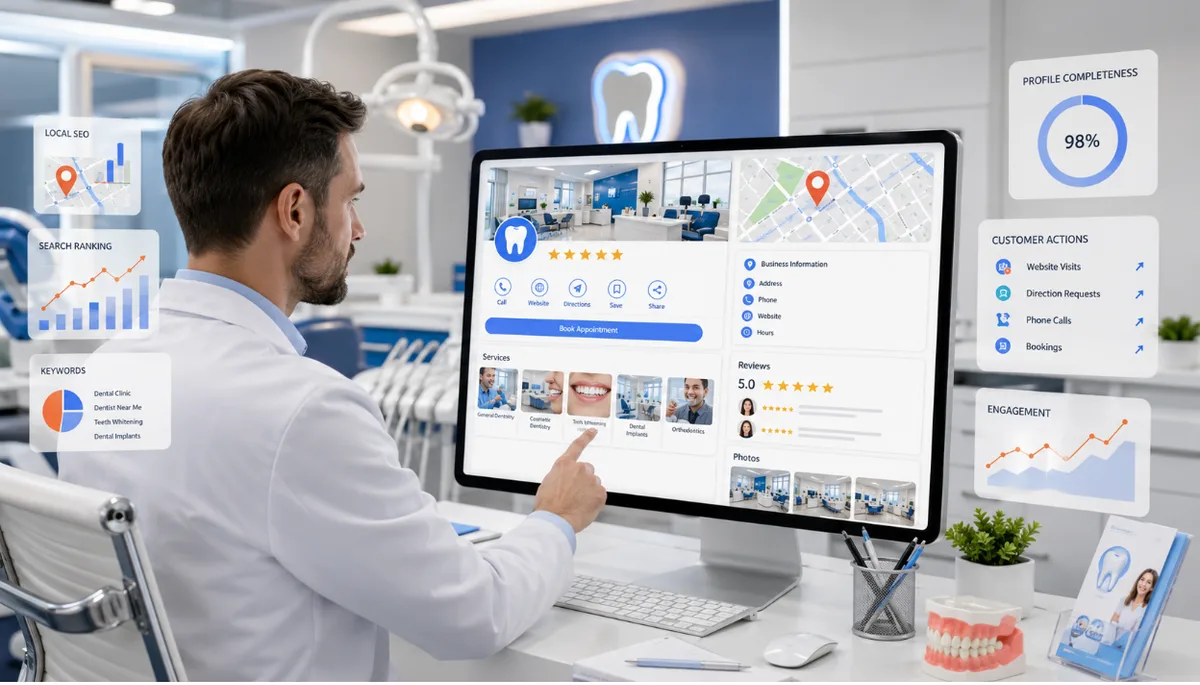
Your Google Business Profile is your most valuable digital asset — for many practices it books more appointments than the website. Set it up completely, then keep it active. (New to it? Start with how to set up a Google Business Profile, then add the dental specifics.)
Choose specific categories. Set "Dentist" as your primary, then add secondaries for what you actually offer: "Cosmetic Dentist," "Pediatric Dentist," "Emergency Dental Service," "Orthodontist," "Oral Surgeon," "Dental Implants Periodontist," "Teeth Whitening Service." The right categories are a direct relevance signal, and most competitors use just one.
List services in patient language. Fill the Services section with every treatment and describe each in plain words patients use — "root canal treatment," "same-day emergency care," "Invisalign," "dental implants" — not clinical jargon. This helps you surface for treatment-specific searches and lets AI systems understand exactly what you provide.
Use real, compliant photos. Exterior with signage, reception, operatories with modern equipment, and named team photos beat stock images and signal an active practice. Important: before/after patient photos require written patient consent that specifically covers online use, and any shot with patients in the background needs a release.
Post weekly and keep NAP consistent. Regular Google Business Profile posts that mention specific treatments reinforce relevance. And your Name, Address, and Phone must match exactly everywhere — mismatches quietly weaken your rankings.
The HIPAA Layer: Reviews Done Right

Here's what most dental SEO guides gloss over, and where practices get into real trouble. Reviews are your single strongest ranking and trust signal — but you operate under HIPAA, and the rules apply directly to how you request and respond to them. A quick note first: this is general guidance, not legal or compliance advice, so confirm specifics with a HIPAA compliance professional.
Asking for reviews the compliant way. Do actively cultivate reviews; don't wait for them. An automated text or email sent shortly after an appointment, with a direct link to your Google review page, is the most reliable method. What matters for compliance: never disclose that someone is a patient or reference their treatment in the request, and keep the ask general — "If you had a good experience, we'd appreciate you sharing it." A well-designed review system automates this without crossing the line. (Our general reviews playbook covers the mechanics; the rules here are the healthcare overlay.)
Responding to reviews — the trap. This is where practices slip and get fined. The core rule: never acknowledge that a reviewer is a patient — even if they identify themselves — and never mention treatment, dates, or any health detail in a public reply. The ADA has noted that responding to a negative review can itself constitute a HIPAA violation, and penalties can reach tens of thousands of dollars per incident. Keep every reply generic and take specifics offline.
Safe response templates you can adapt:
- Positive: "Thank you for the kind words. We're glad you had a good experience and appreciate you being part of our community."
- Negative: "We take all feedback seriously and want to make things right. Please contact our office directly so we can help."
Don't defend, don't explain, don't confirm anyone as a patient. Aim for a steady flow of new reviews — a few a week keeps you competitive so the occasional negative one is buried by fresh positives.
Keyword Strategy: Speak Like Your Patients
Patients don't search in dental-school terms. They describe symptoms, urgency, and money. "Endodontic therapy" barely gets searched; "root canal near me open Saturday" books appointments. Build your keywords around patient language.
Two high-value patterns competitors underuse:
Insurance intent. A huge share of patients search "dentist that takes [insurance] near me." List the plans you accept on your site and profile, and create content around them.
Treatment plus city. High-value procedures — "dental implants [city]," "Invisalign [city]," "emergency dentist [city]" — draw patients with clear intent and higher lifetime value.
Website and Content: Building Trust Google Rewards
Your profile gets the call; your website earns the trust and supports rankings.
Build a page per treatment, per city. A single "Services" page won't rank. High-value procedures each deserve a dedicated, genuinely detailed page — dental implants, Invisalign, emergency care — with the city and nearby neighborhoods worked in naturally.
Respect E-E-A-T, because dental is YMYL. Dental content sits in Google's "Your Money or Your Life" category, held to the highest standard for expertise and trust. Publish real dentist bios with credentials and specializations, keep clinical information accurate, and make sure a licensed provider reviews patient-facing content. Generic AI-written pages won't cut it here. A fast, mobile-friendly site served fully over HTTPS matters too — it's both a ranking factor and a baseline for handling patient data. This is where website and technical work and content and on-page SEO pay off.
Citations and Dental Directories
Citations — consistent mentions of your practice's name, address, and phone across the web — help Google verify you're a real, established practice. (Full explainer on citations here.)
Beyond the core directories every business needs, dental practices should claim the healthcare platforms patients actually use: Healthgrades, Zocdoc, Vitals, RateMDs, 1-800-Dentist, and your ADA and state dental association listings. These carry authority, send qualified referral traffic, and reinforce your relevance in a way general directories can't. Keep every listing's NAP identical.
A Note for Multi-Location and Group Practices
Groups face traps solo practices don't. Give each office its own Google Business Profile and its own location landing page with unique content and, where possible, a local phone number. Don't reuse the same service descriptions across locations — duplicate content and mixed NAP data cause profiles to compete with each other. Keep a central record of categories, verification proofs, and canonical address formats so nothing drifts.
How AI Search Changes Things for Dentists
Patients increasingly ask ChatGPT, Gemini, and Google's AI Overviews to recommend a dentist before searching the traditional way, especially for high-intent queries like "best dental implants in [city]." These systems don't show ten links — they name one or two practices. The encouraging part: they pull from the same signals as local SEO, leaning on complete profiles, structured FAQ content, named provider credentials, and specific review text. The work you do to win the map pack increasingly doubles as your AI-search strategy.
Measuring What Matters
Track outcomes, not vanity metrics: calls and direction requests from your Google Business Profile, appointment form submissions, map-pack rankings for your treatment-plus-city terms, and the real bottom line — booked new patients. Tie your reporting back to appointments scheduled, since that's what actually grows the practice.
Frequently Asked Questions
Does local SEO work for dental practices?
Yes. Dental searches are high-intent, the map pack captures most local clicks, and a strong organic presence produces a lower cost per new patient than paid ads over time. Because a single patient can be worth thousands over the relationship, local SEO is one of the highest-return channels a practice can invest in.
Can dentists ask patients for Google reviews?
Yes, with care. You can request reviews — ideally through an automated text or email after appointments — but you cannot disclose that someone is a patient or reference their treatment in the request. Keep the ask general and HIPAA-compliant. Never offer anything of value in exchange for a review.
How should a dental practice respond to reviews without violating HIPAA?
Keep every reply generic. Never acknowledge that a reviewer is a patient — even if they self-identify — and never mention treatment, dates, or health details. Thank positive reviewers briefly, and for negative ones, acknowledge the concern and invite them to contact the office directly, taking specifics offline.
What Google Business Profile category should a dentist use?
Use "Dentist" as your primary category, then add specific secondaries for what you offer, such as "Cosmetic Dentist," "Pediatric Dentist," "Emergency Dental Service," "Orthodontist," or "Oral Surgeon." Specific categories improve your relevance for procedure-based searches.
How long does local SEO take for a dental practice?
Most practices see initial movement in local rankings and map visibility within three to four months, with dominant rankings for competitive terms typically taking six to twelve months of consistent work. Your review profile and market competitiveness are the biggest variables.
The Takeaway
Local SEO for dental practices comes down to a focused system: a fully optimized Google Business Profile with the right categories, a steady flow of reviews handled within HIPAA rules, consistent citations across the web and dental directories, and real treatment-and-city content backed by genuine provider expertise. Proximity you can't change, but prominence and relevance are yours to build — and that's what puts you in the map pack when patients are searching.
If managing all of that — profile, reviews, listings, content, and the compliance details — isn't where your team's time is best spent, that's exactly what Oootech's local SEO handles for dental practices. Want to see where your practice stands in local search right now? Grab a free audit and we'll show you what's keeping you out of the map pack.
Keep reading: Local SEO Ranking Factors · What Are Business Citations?
Disclaimer: This article is general information about local SEO and is not legal, medical, or HIPAA-compliance advice; confirm patient-communication and review rules with a qualified compliance professional.