Local SEO for law firms is the work of getting your practice to show up when people nearby search for legal help — "personal injury lawyer near me," "divorce attorney in [city]." It centers on your Google Business Profile, client reviews, accurate citations, and location-specific website content. Done right, it lands you in the Google map pack, the three results that capture most of the calls before a searcher ever scrolls down.
Legal is one of the most competitive and expensive markets in all of search, so the firms that win local aren't the biggest — they're the ones who do this work deliberately. Here's how.
Quick answer: To improve local SEO for your law firm, fully optimize your Google Business Profile with the most specific practice-area category, build a steady stream of client reviews (within your bar's ethics rules), keep your name, address, and phone consistent across all directories, and publish dedicated pages for each practice area in each city you serve. Google ranks local results on relevance, distance, and prominence — and these moves strengthen all three.
What Is Local SEO for Law Firms?
Local SEO for law firms is the process of optimizing your online presence so your practice appears in local search results — the map pack and the "near me" listings — when potential clients in your area look for an attorney.
It's different from traditional SEO. A firm can have a polished website that ranks for broad informational terms and still be invisible when someone in its own city searches for a lawyer. Local search runs on its own signals, its own competition, and its own tools. (Here's the full local vs. traditional SEO breakdown.)
The prize is the Google map pack — the boxed set of three firms with a map that sits at the very top of local results, above the regular links. For legal searches, which are urgent and high-stakes, that placement captures a large share of the calls. Someone facing an arrest or an accident isn't scrolling to page two. They're calling one of the first firms they see.
Does Local SEO Work for Law Firms?
Yes — local SEO is one of the highest-return channels a firm can invest in, for three reasons.
Legal searches carry some of the highest intent online. A person searching "car accident lawyer in [city]" needs help now, not next quarter. They're already deciding, which is why local search traffic converts into consultations at a strong rate.
It's also far cheaper per case than paid ads over time. Legal keywords are among the most expensive in all of Google Ads — single clicks can run into the tens of dollars in competitive markets. A strong organic and map-pack presence keeps producing calls without paying for every click, which usually drives the cost per signed case well below paid search once rankings hold. (We compare the two channels in depth in our SEO vs. Google Ads guide.)
And it compounds. Reviews accumulate, your profile gains trust, and your rankings hold — building an asset that keeps working, unlike an ad that stops the moment you stop paying.
How Google Decides Which Law Firms Rank Locally
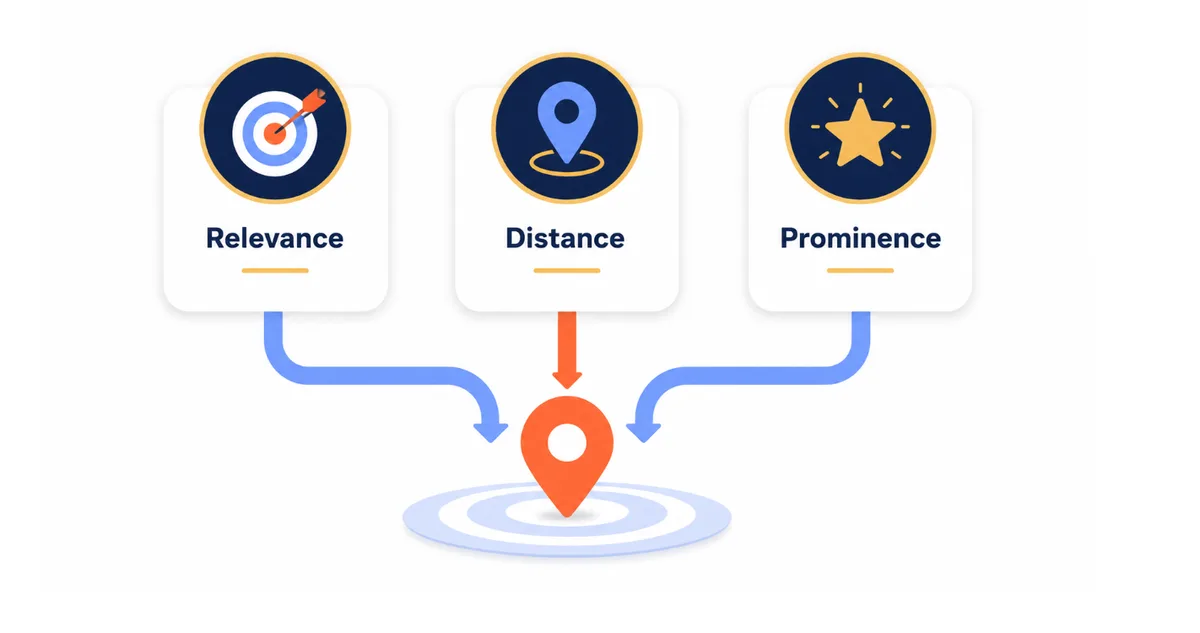
Google ranks local results on three factors. Every tactic below works on at least one of them.
Relevance — how well your firm matches the search. If someone searches "estate planning attorney," Google won't show a personal injury firm, no matter how close or well-reviewed. Your categories, services, and content tell Google what you actually do.
Distance — how close your office is to the searcher. This is the heaviest factor, and the one you can't directly control. You can't outrank proximity, so the goal is to maximize every other signal and to genuinely establish your presence in the areas you serve.
Prominence — how well-known and trusted your firm is, based on reviews, citations, links, and your overall footprint. This is the factor you can move the most through consistent work. (More on the full set of local ranking factors here.)
Optimizing Your Law Firm's Google Business Profile
Your Google Business Profile is the single most important asset in local SEO — often more valuable than your website for generating immediate calls. Set it up completely, then keep it active.
(New to it? Start with how to set up a Google Business Profile, then layer on the legal specifics below.)
Choose the most specific category. Don't settle for "Lawyer" or "Law Firm." If you handle personal injury, set "Personal Injury Attorney" as your primary category. Google has added niche categories like "Probate Attorney" and "Estate Litigation Attorney," and using the exact right one is a ranking signal. Add secondary categories for every other practice area you genuinely offer.
Write a real description. Use the full character count. Lead with your main practice area and city, mention what sets you apart — track record, focus areas, languages spoken — and write it for a human, not a keyword crawler.
Fill the services section completely. List every practice area with a short description. Most firms leave this empty, which is a missed relevance signal.
Use real photos. Office, team, attorney headshots, community involvement. Skip the stock courtroom imagery — authentic photos build more trust and tend to earn more profile engagement than generic stock images.
Handle the statewide-license nuance. Many firms are licensed across an entire state but have one physical office. If you serve clients only at your office, show the address. If you genuinely serve a wider area, set up service areas thoughtfully — but don't claim a fake presence in cities where you have no real footing. Google is good at spotting that, and so are clients.
Keep NAP consistent. Your Name, Address, and Phone number must match exactly everywhere. "Suite 400" on your site and "Ste. 400" on a directory is a mismatch that weakens your signal. We'll come back to this under citations.
The Compliance Layer: Reviews and Bar Ethics
Here's what most local SEO guides skip, and where law firms get into real trouble: the ethics rules that govern attorney advertising apply directly to your online presence — your profile, your directory listings, and especially how you handle reviews. Getting rankings while breaching your bar's rules is not a win.
A quick, important note: the following is general information, not legal or ethics advice, and state bar rules vary. Treat it as a starting point and confirm the specifics with your own jurisdiction.
Asking for reviews — what's allowed. You can ask satisfied clients for honest reviews. Under the ABA Model Rules, soliciting genuine, non-coerced feedback is permitted. What you cannot do:
- Offer anything of value — discounts, gift cards, referral credits — in exchange for a review. ABA Model Rule 7.2(b) bars giving something of value for recommendations, fake or paid reviews ("astroturfing") also violate FTC rules, and incentives breach Google's policies on top of that.
- Tell clients what to write or script their reviews.
- Encourage clients to share confidential details of their matter. Brief them gently: "Just share how working with us felt — no need to describe the specifics."
Some states add a layer: testimonials may require a disclaimer. New York, for example, requires language like "Prior results do not guarantee a similar outcome." Check your bar before you build your review system.
Responding to reviews — the confidentiality trap. This is where firms slip. ABA Model Rule 1.6 prohibits revealing information related to a client's representation. That applies to your review replies — even positive ones. You cannot confirm someone is a client or discuss what you did for them in a public reply. A warm, brief "thank you" is the ceiling.
Negative reviews are riskier still. Under ABA Formal Opinion 496, a negative review does not free you to disclose confidential information in self-defense, and even a general statement that the review is inaccurate can itself reveal that you were involved in the matter — a potential breach. The safe move is a short, restrained reply that takes the conversation offline.
Safe response templates you can adapt:
- For an unhappy client: "Thank you for your feedback. Our professional obligations prevent us from discussing any specifics publicly, but we take all concerns seriously. Please contact our office directly so we can discuss this."
- The ABA's own suggested line: "Professional obligations do not allow me to respond as I would wish."
- If the reviewer was never a client: a measured note that you have no record of representing them and inviting direct contact (still without disclosing anything).
Don't defend. Don't explain. Don't identify the person as a client. If a review violates Google's policies (spam, hate speech, clearly not a client), flag it for removal instead of arguing in public.
The best defense against a bad review is a steady flow of good ones. A managed, ethics-compliant review system keeps real reviews coming in after each matter resolves, with response handling that stays inside the rules — which is exactly the kind of process we build.
Why velocity matters. Google rewards a consistent stream of fresh reviews over a pile of old ones. A couple of new reviews a week beats fifty uploaded once a year. Reviews feed the prominence factor directly, and they now feed AI search results too.
Website and Content: Building Local Authority
Your profile gets the call. Your website earns the trust and supports the rankings. For law firms, content strategy has a specific shape.
Build a page for every practice area in every city. A single generic "Practice Areas" page won't rank in 2026. A personal injury firm serving three cities needs dedicated, genuinely different pages — "Car Accident Lawyer in [City]," "Slip and Fall Attorney in [City]" — each with local detail: nearby courts, county references, real specifics. Thin, duplicated city pages do more harm than good.
Respect E-E-A-T, because legal is YMYL. Law sits in Google's "Your Money or Your Life" category, held to the highest scrutiny for expertise and trust. Real attorney authorship, genuine case results, accurate information, and actual experience matter more here than in almost any other industry. Mass-produced AI content is a real risk for firms that live on credibility. Write like the expert you are. A fast, mobile-friendly site matters too, since most legal searches happen on phones — this is where website and technical work pays off.
Add schema markup. Structured data (LegalService or Attorney schema, plus LocalBusiness) helps Google understand your firm, services, NAP, and areas served, and can improve how you appear in results. It's part of solid technical and on-page SEO.
Citations and Legal Directories
Citations — mentions of your firm's name, address, and phone across the web — help Google verify you're a real, established business and support your prominence. For law firms, two layers matter:
Core citations on the major platforms every business needs, kept perfectly consistent. Inconsistent NAP is one of the most common and damaging local SEO errors.
Legal-specific directories — Avvo, FindLaw, Justia, and Martindale. These carry high authority, rank strongly for attorney-name searches, and give you a citation, a backlink, and a second ranked result when someone searches your firm. Avvo in particular is a near-essential profile for attorneys. For the broader list of platforms worth claiming, see our guide to the best local business directories, and consider managed listings if keeping dozens consistent isn't a good use of your time.
Local Link Building for Law Firms
Local, relevant backlinks strengthen your authority and your local relevance. Strong sources for firms include local bar association listings, sponsorships of community events or local teams, scholarships, guest articles in local publications, and partnerships with non-competing local businesses. Legal directories double as both citations and links. Quality and local relevance beat raw volume.
Local Services Ads (Google Screened) for Lawyers
Worth knowing alongside SEO: Local Services Ads sit at the very top of results, above the map pack, on a pay-per-lead basis. For lawyers, they carry the "Google Screened" badge, which means Google has verified the firm's license, run background checks, and confirmed the business — a strong trust signal that tends to convert well.
LSAs and local SEO aren't competitors. LSAs are paid placement for immediate leads; local SEO is an organic asset you build over time and don't pay per click for. New firms that need cases now often start with LSAs while their organic presence grows. The strongest setups use both.
Measuring Local SEO Success
Track outcomes, not vanity metrics. The numbers that matter for a firm:
- Calls and direction requests from your Google Business Profile (visible in profile insights)
- Map-pack and local rankings for your practice-area-plus-city terms, ideally with grid-based tracking that shows visibility across neighborhoods, not just a citywide average
- Organic traffic by city and practice-area page
- Consultations and signed cases — the real bottom line
Local SEO success is ultimately measured in signed clients, so connect your tracking back to consultations booked, not just impressions.
How AI Search Changes Local SEO for Law Firms
When someone asks ChatGPT, Perplexity, or Google's AI Overviews for a good attorney, they get a direct recommendation, not ten links. The encouraging part: these systems lean heavily on the same signals as local SEO — a complete, consistent profile, strong reviews, and authoritative content. Reputation carries real weight here, so a pattern of weak reviews that never hurt your rankings could quietly keep you out of AI answers. The work you do to win the map pack increasingly doubles as your AI-search strategy.
Common Mistakes Law Firms Make
- Using "Lawyer" instead of the specific practice-area category
- Inconsistent NAP across the website and directories
- Incentivizing reviews or scripting them (an ethics and policy violation)
- Replying to reviews in a way that risks client confidentiality
- One generic services page instead of practice-area-by-city pages
- Treating local SEO as a one-time project rather than ongoing work
- Mass-produced AI content on a site that lives or dies on trust
Frequently Asked Questions
What is local SEO for law firms?
Local SEO for law firms is the practice of optimizing a firm's online presence — Google Business Profile, reviews, citations, and location-specific website content — so it appears in local search results and the Google map pack when nearby clients search for legal help. It targets high-intent searches like "[practice area] attorney near me."
Does local SEO work for lawyers?
Yes. Legal searches are high-intent and convert well, the map pack captures most local clicks, and a strong organic presence produces a lower cost per signed case than paid ads over time. Because legal keywords are among the most expensive in paid search, local SEO is one of the highest-return channels available to a firm.
Can lawyers ask clients for Google reviews?
Yes, with limits. Under ABA Model Rules, attorneys can ask satisfied clients for honest reviews, but cannot offer anything of value in exchange, tell clients what to write, or encourage them to share confidential details. Some states also require testimonial disclaimers. Always check your state bar's specific rules.
How should a law firm respond to a negative review?
Carefully and briefly, without revealing confidential information. Under ABA Formal Opinion 496, a negative review doesn't permit disclosing client information in self-defense, and even saying a review is inaccurate can reveal you were involved. The safe approach is a short, professional reply inviting the person to contact your office directly, taking the matter offline.
What's the most important local SEO factor for law firms?
Proximity (distance) is the heaviest factor Google weighs, and you can't directly control it. The factor you can move most is prominence — reviews, citations, and your overall reputation — followed by relevance, which you control through accurate categories, services, and local content.
How long does local SEO take to work for a law firm?
Most firms see meaningful movement within a few months, with stronger results over six to twelve months as reviews accumulate and Google builds trust in the profile. Competitive markets and the strength of your review profile are the biggest variables.
The Takeaway
Local SEO for law firms comes down to a focused system: a fully optimized Google Business Profile with the right practice-area category, a steady flow of reviews handled within your bar's ethics rules, consistent citations across the web and legal directories, and real local content for every practice area and city you serve. Proximity you can't change, but prominence and relevance are yours to build — and that's what moves you into the map pack.
If managing all of that — profile, reviews, citations, content, and the compliance details — isn't where your time is best spent, that's exactly what Oootech's local SEO handles for firms. Want to see where your firm stands in local search right now? Grab a free audit and we'll show you what's keeping you out of the map pack.
Disclaimer: This article is general information about local SEO and is not legal or ethics advice; confirm advertising and review rules with your state bar.